


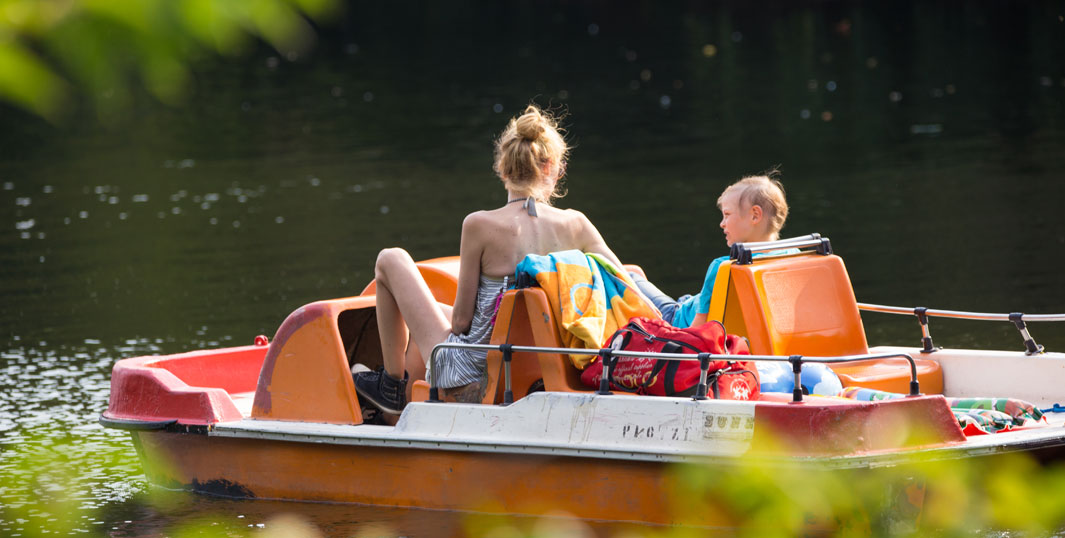
The area around Plötzensee begins directly behind Volkspark Rehberge. Part of the site consists of a disused cemetery, where only a few fragments remain to indicate that it was once a burial ground. Behind the Hans-Schomburgk-Promenade, people now lounge on the so-called Zombie Meadow (a local Berlin expression) during the summer, unaware of what might still lie beneath them. Next to Zombie Meadow is another cemetery for soldiers and civilians who died during the war years and could not be identified. A 1.7-kilometre path runs around Plötzensee. On the southern shore of the lake is the now-legendary Fischerpinte, a pub with a 1970s atmosphere that, in addition to food and drink, also rents out rowing boats and pedal boats. Like the owners of the pub, the interior and the boats are now all in considerable need of renovation.
The Strandbad Plötzensee lido was built in the 1920s, almost at the same time as the Volkspark Rehberge to the east. Like the park, the lido was intended to provide recreation for the mainly working-class residents of Wedding. It was completed in 1928. The entire site, including its buildings, is now protected as a historic monument. The lido was designed by Rudolf Germer, while the buildings were architecturally designed by Walter Krüger and Johannes Krüger. To create the beach, the lakeshore was excavated and artificial sand was added. Plötzensee is designated as a landscape conservation area. In 2010, the entire shoreline outside the lido was fenced off to prevent people from swimming there unofficially during the summer. That has not stopped people from climbing over the fence and taking a free swim when the weather is good. In summer, the Steingarten, directly opposite the paid Strandbad Plötzensee, is particularly lively with people enjoying a free dip.






Add comment