


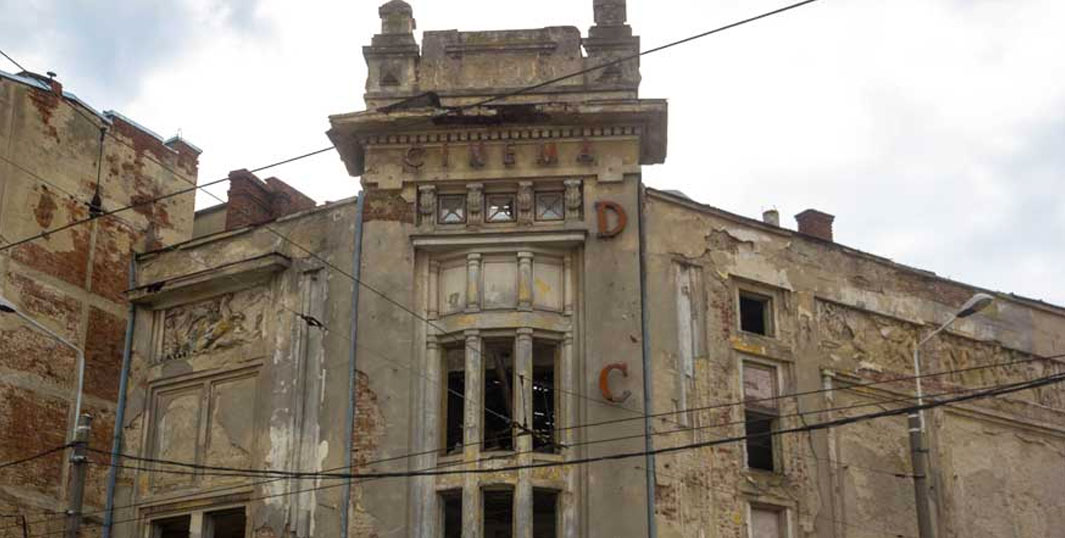
 It looks as though the last performance here was quite some time ago...
Romania had always been on my travel list, but somehow I had never got around to visiting the country. Perhaps that was also because this EU member state does not have the best reputation. But how much truth is there in all the talk? Time to find out and head to the country's capital. The journey from Berlin was quick and painless, taking two hours. Bucharest has two airports, which are only a few kilometres apart (what is the point of that?). After arriving at Otopeni Airport, I first had to go through passport control. A little unusual for a European trip. Unfortunately, Romania was not yet part of the eurozone. The euro was not due to be introduced until 2019. Exchanging money is always a bad idea, as you never get the correct rate. But to have at least a little cash on me, I had to sacrifice 20 euros at a criminal exchange rate. There are several ways to get from Otopeni Airport into the city. The cheapest option is express bus 780 or 783. The buses stop one level below the arrivals hall. Tickets must be purchased at the RATB kiosk located there. Check your change (rip-off). Hold the ticket against the validators on the bus (there are machines at the front and back).
The ride on bus 780 to Gara de Nord station takes 20 minutes. Do not throw away your ticket; it is also valid for the return journey. Of course, nobody tells you that. Taxis are very cheap in Bucharest. To get from the airport into the city, taxi tickets must be obtained from a machine in the arrivals hall. You hand these to the driver, which prevents rip-offs. This system does not work for trips from the city to the airport. A taxi to Otopeni Airport should not cost more than 12 euros. Bucharest is relatively compact and comparable in size to Vienna. However, getting around the city by bus and tram is extremely difficult if you do not know the area. There are hardly any clearly visible stops. Timetables? Forget it. The easiest option is the Bucharest Metro. A day ticket for the metro costs 8 lei (1.90 euros, as of 2016). You can buy one from a machine in the underground station. It does not speak German, but its English is quite understandable. However, there is not a machine on every corner. Be careful: metro tickets are not valid on buses and trams, and vice versa! The Bucharest Metro system is not particularly easy to understand. However, anyone should be able to get the hang of it after a short time. Some stations are quite confusing, with six or more exits and endless corridors. You really need to know which exit you need if you want to avoid a huge detour. The Bucharest underground system was built sometime in the 1970s. Some stations still look that way today. The metro trains, however, are not quite so old. Passenger information on the Bucharest Metro is poor, as is the signage for interchanges.
But back to the city. What is there to see in Bucharest? The Lipscani district, where an endless amount of construction, renovation and painting is currently going on. Compared with other Eastern European cities, however, Bucharest's historic old town does not really stand out. Even when the historic centre of Bucharest has been completely renovated, the city will never catch up with other Eastern European cities. The “old town” in Bucharest is likely to become little more than a party and drinking strip for tourists. Even now, one bar follows another. Because of the extreme construction noise, it was hardly possible to sit anywhere for long. Outside the historic centre, Bucharest seemed completely haphazard and overbuilt to me. Just a 15-minute walk from Lipscani is another highlight of Bucharest: the Palace of the Parliament, supposedly the second-largest building in the world by floor area. Unfortunately, an event was being set up in front of the parliament building during my visit, blocking any view of the monstrous structure. Bucharest has many small parks and green spaces. Unfortunately, these oases are always surrounded by busy roads. As a result, noise levels were high even inside the green spaces. This was particularly noticeable in Kiseleff Park. The average Bucharest resident does not seem to mind, though. One of the few real oases in this otherwise rather drab city is in the north. Herăstrău Park is a huge recreational area well worth exploring. There are numerous places to eat along the banks of several small lakes. Even during the week, the restaurants were popular with businesspeople, especially at lunchtime. Prices are comparable to those in the touristy old town. Unfortunately, there was no time left to explore the entire area. For me, Herăstrău Park was clearly the most beautiful spot in the city.
The area around Gara de Nord, where my hotel was located, had the charm of a typical railway-station district. Unattractive during the day; at night, alcohol and prostitution.
Particular attention is always required in Bucharest traffic. Hardly anyone follows the rules here. Pedestrian crossings are purely decorative.
Service in Bucharest is on a par with that in other Eastern European countries. In other words, it is practically non-existent. In almost every bar where I sat outside, I had to go inside to place my order. Nobody came out to serve. Service at the hotel was a disaster as well. It was officially advertised as having a 24-hour reception, yet there was simply nobody at the desk for half an hour. Nobody should have any expectations in this regard. Please or thank you – even that is apparently too much to ask.
Few people in Bucharest speak English, and if they do, they tend to be younger. This can make buying tickets or asking questions about public transport difficult. Often, it simply does not work at all. However, I also met some genuinely nice people who were very helpful. Even they do not always know their way around the confusing system.


Conclusion: In its current state, Bucharest is a city that nobody really needs to have seen. There are some beautiful corners, but they are quite limited. There is not really much to see or discover. I found the city pretty dull even outside the centre. Even the abandoned places were in such a state that they were not worth photographing. Otherwise, the city simply seemed overbuilt and noisy. There are better destinations for a city break. The prices in Bucharest are worth mentioning. And otherwise? Nothing. For me, Bucharest is the ugliest European city I have visited so far. Nobody needs to stay here for more than a day. That is enough time to see what is worth seeing. All in all, the city struck me as a third-world country: gloomy, drab and unsettling.



Comments
We’re actually planning a groundhopping trip there precisely because of the contrasts that exist in that place. And you’ve taken some really beautiful photos, too!!!
The mere fact that you keep spamming my comment section shows me that something is seriously wrong with you. You must have a lot of free time—and a lot of pent-up frustration. I suppose you think your opinion is the only one that matters, and that being a know-it-all or a smart-ass is what defines your life. I’m sorry I didn’t write what you wanted to read, but that’s something you’ll just have to live with. Any further comments from you will be deleted unread.
For the sake of completeness, regarding the metro system, a simple glance at Wikipedia would have sufficed: https://en.wikipedia.org/wiki/Bucharest_Metro, under the "Rolling stock" section. Now, tell me—how could anyone claim that their trains aren't among the most modern? (They received 16 trains in 2014 alone, with another order of 8; even the previous-generation models look quite new.)