


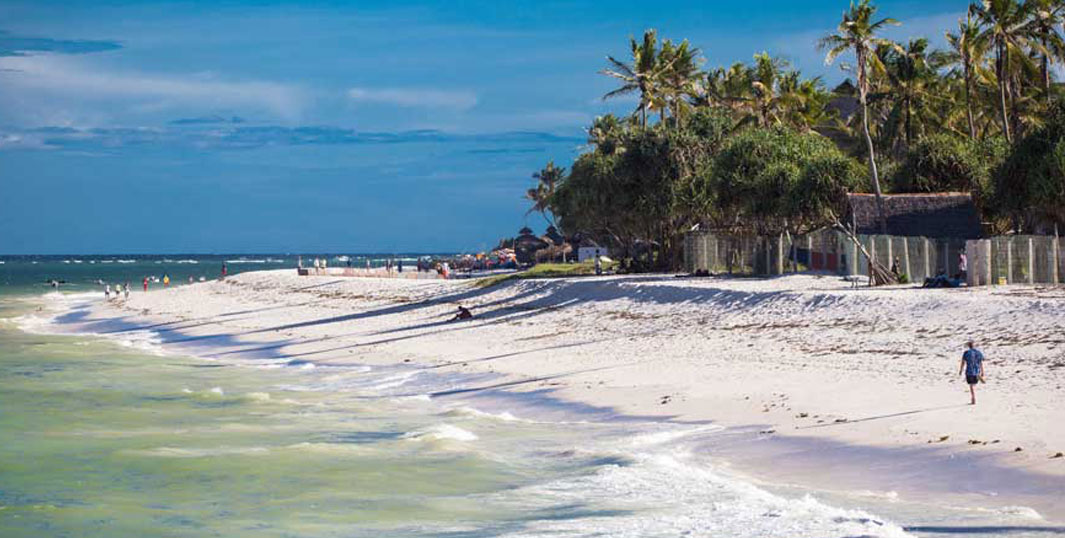
 Beautiful and clean – Diani Beach
These days, there are not many travel destinations outside Europe that can still be considered reasonably safe. Central Africa is hardly worth mentioning in that regard. The options are often limited to exclusive destinations such as Tanzania, Namibia, South Africa....or Kenya. In Kenya, too, visitors are spoilt for choice: a beach holiday, nature and safari, or perhaps a combination of both. The latter appealed to me most, because a safari alone can quickly become stressful and can also cost thousands, especially when travelling alone. So I decided to start small and get to know the country and its people before moving on to the bigger adventures. And so it was. Here is my little travel report from Kenya. Reasonably good package deals can be found on Kenya’s south coast, particularly in the low season. The long rainy season runs from April to July, which also brings the worst and coldest weather of the year. Things get busy again on the south coast between August and December, especially around Diani Beach, supposedly Kenya’s most beautiful stretch of coastline. Tiwi Beach is not far away. That is where I booked a 14-day stay at the Amani Tiwi Beach Hotel. But the 14 days never happened. A few weeks before departure, Turkish Airlines simply cancelled the return flight scheduled for Sunday, which meant that in the end I had only 13 days for this long journey. Unfortunately, the airline cancelled the flight more than two weeks in advance, leaving hardly any chance of claiming compensation. Depending on the distance, such a claim can amount to as much as 850 euros in the best-case scenario.
Of course, there was another little snag on this trip to Kenya. Even in 2018, Berlin still did not have an international airport, so the journey included a stopover in Istanbul. But that was not all on the outbound flight. We also made a brief stop in Tanzania before continuing from Mount Kilimanjaro to Mombasa. Annoying and time-consuming, but apparently there was no other option. We arrived 1.5 hours late as a result. It was also quite interesting to see that many tourists at Mombasa airport had no idea during passport control that a tourist visa was required for Kenya. You can obtain one online in advance or apply and pay for it directly at the airport. There were some rather long faces. It is always a good idea to check the entry requirements for the country you are visiting beforehand. You can find out how to apply for an online visa for Kenya here.
We then headed for the south coast in a minibus packed to the roof with passengers and suitcases. To reach the south coast, we had to cross on the Likuni Ferry. The ferry is the only connection between Mombasa’s old town and the southern mainland. Early in the morning, this was not much of a problem. During the day, however, things look rather different – especially if you are not sitting inside a vehicle. More about that later.
The journey to the hotel at Tiwi Beach, Kenya, took about an hour. The final stretch to the hotel was quite a bumpy ride. Only the very last part of the road through the bush was paved with concrete. The following day, the hotel was quite busy. Many locals had used the Easter weekend for a holiday on the south coast. Once the holidays were over, the crowds quickly disappeared, and the Amani Beach Hotel was largely deserted for the next two weeks. That was due to the low season, though, not because the hotel was so bad. My first impression of the grounds and the beach was quite satisfactory. It soon became clear, however, that Tiwi Beach cannot really compete with beaches in the Caribbean. Kenya does have plenty more to offer, though – for example, its incredible wildlife. Even at the hotel, a large family of monkeys was roaming around early in the morning. There was plenty of activity in the bush behind the hotel, too. There was something crawling, scurrying and fluttering around at every turn. Not everyone’s cup of tea. Since the Amani Beach Hotel is very secluded and, with its wall and security staff, felt rather like a prison, I wanted to explore the surrounding area.
Infrastructure? Virtually non-existent. The only way to get to Diani Beach was by tuk-tuk or motorbike taxi (about 200 KES to Diani). These forms of transport are not always waiting outside the hotel, especially when the hotel is almost empty. In that case, your only options are an expensive taxi or asking one of the staff members who may have a number and can call a motorbike taxi to pick you up. By the way, the currency in Kenya is the Kenyan shilling. At the time, the conversion was quite simple: 100 Kenyan shillings were almost exactly one US dollar. Diani Beach can also be reached on foot from Tiwi Beach by walking along the shore. The popular beach bars in Diani are about four kilometres away. Going by road would probably take half a day, and the route does not always pass through areas where you feel comfortable. In short: Tiwi Beach and its hotel are suitable only for people who want to spend their entire holiday at the hotel. You can find my detailed review of the Hotel**** Amani Tiwi Beach here: click here.
Getting from Tiwi to the nightlife in Diani Beach is therefore quite a hassle. Diani Beach has several bars that are popular and busy during the season (Bidi Badu, Forty Thieves, Kim for Love). The nightclubs nearby (Tandoori Bar, Shakatak) are full of sex workers, many of whom travel from the interior in large numbers during the season and share a room for that period. Men travelling alone who have a problem with this should generally avoid the bars and clubs in Diani. Even the least attractive male visitor will rarely be left alone for long.
Diani Beach itself is a rather unattractive place and hardly differs from other third-world towns in Africa. Despite the country’s Christian character, the coast in particular has a large Muslim population. There is a mosque on almost every corner. The beach at Diani is beautiful, but chaos begins as soon as you step behind it. Dirt and noise define the town. The beach presents the same picture as elsewhere: beach boys, begging and plenty of rip-offs. At least you can usually enjoy some peace in most beach bars, away from the pushy vendors. At Forty Thieves, for example, Maasai security staff make sure that guests are not pestered by the roaming salesmen. There are many restaurants in Diani Beach town, and they are somewhat cheaper than the places right on the beach. If you would like to try some local food, I recommend Swahili Pot. It is a very simple restaurant serving delicious dishes for hardly more than five euros. Unfortunately, Swahili Pot has a real problem with service and organisation. Some dishes and drinks are often unavailable. It is sometimes best to ask in advance which food and drinks they actually have. That can save you a lot of time. Not far from Swahili Pot is the Rongai Eating House. This is a simple restaurant where meat is grilled by the roadside. The meat is put straight on the grill without seasoning and can become very tough. Still, it is worth a visit because it is authentic and inexpensive. One more thing: many bars and restaurants claim to accept credit cards. In most cases, however, this is not true. If you plan to pay by card, it is best to ask beforehand whether this is actually possible. Apart from a few bars and restaurants, Diani Beach unfortunately does not have much to offer. But what is the north coast like?


There are not many ways to get from the south coast to the north coast. Your options are basically a taxi or the many minibuses that run between Diani and Mombasa every few minutes. You cannot tell where the minibuses are going. Simply stand facing north and listen to the drivers calling out their destinations, or shout out your own destination. The best place to catch a bus to Mombasa is the area in front of Gate Mall. Do not be put off by the aggressive behaviour of the bus operators. A trip from Diani Beach to Mombasa costs no more than 200 KES per person. You pay during the journey. It is best to have the exact amount ready. In general, getting change in Kenya can be difficult. The buses take you only as far as the ferry. From there, things become rather unpleasant. To board the ferry, you have to join the crowds. When the ferry arrives, thousands of people more or less push their way on board together. You spend ten minutes standing packed tightly together and feel as if hundreds of hands are groping you. I spent the entire time concentrating on my bags and luggage. It was an extremely uncomfortable situation. I felt as though I would leave the ferry completely naked. Nevertheless, everything went well, more or less. I still had my phone and money. On the other side, we continued in the next minibus. Inside, it was scorching hot, and the bass from the sound system made the whole bus vibrate so much that I almost bounced off the ceiling. After a brief stop at the legendary Florimon Bar (now partly a lost place), with a view of Mombasa harbour entrance, we continued to Mtwapa. The journey took just under an hour. The sun was already slowly disappearing, so we quickly headed to the beach. The tuk-tuk driver took us to Maweni Beach at sunset. I cannot understand the many positive reviews of this stretch of beach. It was dirty, with boring and awful bars. Simply ugly. Once it was dark, we went looking for a hotel. In the low season, this is usually no problem. With three people, however, it became a little difficult. Even when we offered to pay extra, many accommodation providers refused us. Eventually, the three of us found a room at the Prime Comfort Hotel And Apartments. A decent budget place that did not care how many people checked in. After a night of heavy drinking, we headed back towards Mombasa. This time we stopped at the notorious Bamburi Beach. This beach was already much nicer than Maweni Beach, although it could not compare with Diani Beach. Very little effort had been made to maintain it. There was dirt and algae everywhere.
Haller Park is located not far from Bamburi Beach. It is a kind of wildlife park next to the Bamburi Cement Factory. Despite the outrageous entrance fee of 13 euros, we paid a visit to the open-air animal enclosure. See also the report on Haller Park. In the evening, we were back in Mombasa and took the ferry back to the south coast after stopping at the Blue Room restaurant (expensive).


Going on safari in Kenya is an expensive business, especially if you join organised groups. Tour operators make enormous profits from these trips. But there is another way. Since Tsavo and the other parks were too far away for me, I at least wanted to visit Shimba Hills. This reserve is about 45 minutes from Diani Beach. Tour operators charge exorbitant prices for a day trip to Shimba Hills. 130 euros per participant is outrageous, and unfortunately not uncommon. With eight participants, that means 1,040 euros for the operator. Incredible. It is much cheaper to organise the trip yourself: hire a driver and a vehicle, then pay the park entrance fees per person and for the vehicle. With the same number of participants, the total comes to no more than 180 euros. Everyone can decide for themselves whether to buy food. That is 860 euros less. I hired a vehicle with a driver and spent a day in Shimba Hills. You can read my report here. I will be happy to share the contact details. Trips to almost all national parks are also offered from Diani at prices far lower than those charged by beach operators, hotels or local travel agencies.
Diving is also possible on Kenya’s south coast. However, just as with safaris, it is extremely overpriced. This is also due to the lack of competition. During my stay, I counted only three dive schools in the area around Diani Beach.
Of course, I did not always feel like travelling around every day. I also spent many days at the beach. As mentioned at the beginning, however, this is not always relaxing, depending on exactly where you are staying. A walk along the beach often turns into a real obstacle course. Even when accompanied by locals, you can be followed for kilometres. A simple “no” is unfortunately often not enough. The pushy sellers of all kinds of goods do not give up easily. The only place where I really found peace was on the hotel’s own beach.
Thirteen days pass in the blink of an eye. Before long, it was time to head home, and that brings my travel report from Kenya to an end. But the return journey was anything but smooth, either. Just as on the outbound flight, there was a major delay. As a result, I missed my connecting flight in Istanbul. I arrived back in Berlin five hours late – and my suitcase was missing. It turned up four days later, completely wrecked. Now I will probably have to spend ages chasing compensation for the missed flight and the suitcase. I hope my travel report from Kenya has not bored you.
Conclusion: I really enjoyed my trip to Kenya. The problems before and after the holiday do not change that. Kenya is too far away for a beach-only holiday; there are more attractive destinations for that. But I can warmly recommend Kenya to wildlife lovers and people who enjoy exploring. The people are friendly and approachable. It was great fun mingling with the locals. I will definitely visit the country again.
Next time, though, without a package tour and with new destinations. And there will be a new travel report from Kenya. Also read the second travel report from Kenya and my third travel report. Or read how to get 600 euros in compensation from Turkish Airlines.


Add comment