


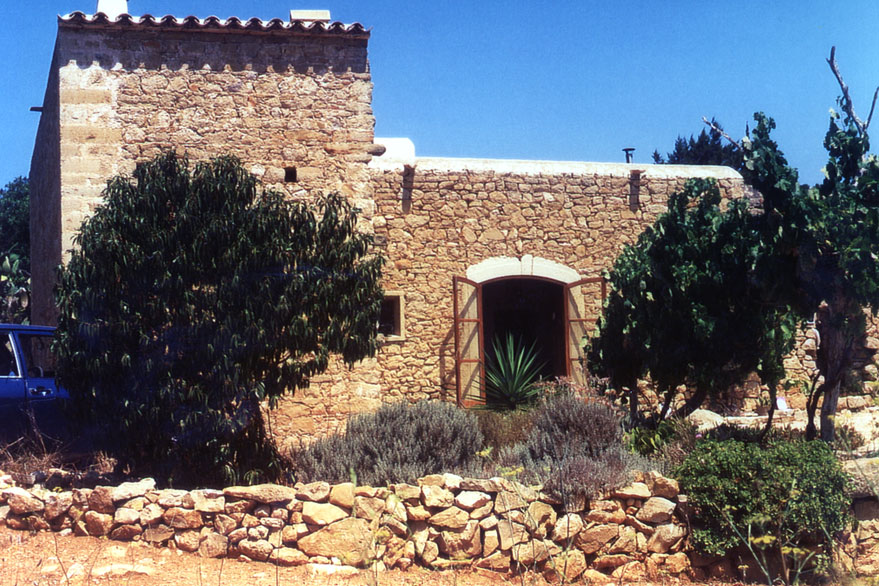
Originally, a completely different trip had been planned. On a beautiful summer's day in 1995, Kai Robert (the living legend from FOVGE 2a, Braunschweig, class of 1994), one of his friends (who had just drunk away his driving licence) and I were sitting in a newly built apartment in Niebüll, discussing a holiday. The plan was to travel far afield, to California, where a sister could put us up. Somehow that never happened, and in the end we went via Hamburg to Ibiza, the beautiful Balearic island in the Mediterranean. The advantage was that we could stay free of charge in a small house (“Villa Tanit”) out in the sticks. The downside: no electricity, no running water and no sanitary facilities. Going to the toilet in the wilderness, candles and campfires at night, water from a cistern—in short, camping in the wild. The little house was in the north of the island, about two kilometres from the Mediterranean. Infrastructure: absolutely none. This was a serious drawback when the nearest supermarket was several kilometres away. We therefore unanimously decided to find a rental car somehow. That was no easy task on an island that was almost fully booked during the peak season. But Kai, a gifted organiser, set off hitchhiking to the nearest larger towns in the morning and actually came back with a rental car. To this day, I cannot explain how he managed that under such unfavourable circumstances. From then on, despite the modest living conditions, our stay became considerably more comfortable thanks to the added flexibility. We could explore the island, shop and drive to beaches. With the car, we were also able to obtain a gas cylinder, which in turn allowed us to cook and run the refrigerator. The biggest problem was the water supply, because it turned out that the cistern was full of dead geckos. The water was not even suitable for showering. Personal hygiene was therefore possible only with water canisters we brought in or by using the showers at the public beach. Fortunately, Villa Tanit was not far from the sea. After a 30-minute walk through the scorching countryside, we reached the Mediterranean. But there was no fancy sandy beach with beer kiosks and entertainment waiting for us. Instead, there were barren rocks and crystal-clear water. No people in sight. It may not be very comfortable to spread your towel on a rock, but that did not bother me; I thoroughly enjoyed the seclusion and peace by the sea. Every now and then, though, we also visited a public beach. The public beach at Benirràs remains unforgettable. In 1995 it was still relatively empty and undeveloped, more of a meeting place for alternative travellers and old hippies. On the walk back to the car park one night, I suddenly heard a very distinctive voice in the darkness. It was Nina Hagen, arguing with her daughter Cosma Shiva Hagen about which people she was allowed to take home from the beach. It was an interesting conversation, of which I became an involuntary witness.
Conclusion: I enjoyed the two weeks of alternative living on Ibiza, despite the many inconveniences. Somehow, managing without any comfort worked quite well. It was an experience worth having, although perhaps not one I would want to repeat. I did not see much of the island, so I cannot report on that either. As a result, I completely missed out on the mass tourism in the north of the island. It was a quiet, very relaxing and somewhat adventurous holiday.





Add comment