


- Details
- Hendrik Lorenz
- Western Europe
- Category: Germany
- Read Time: 4 mins
- Hits: 5834
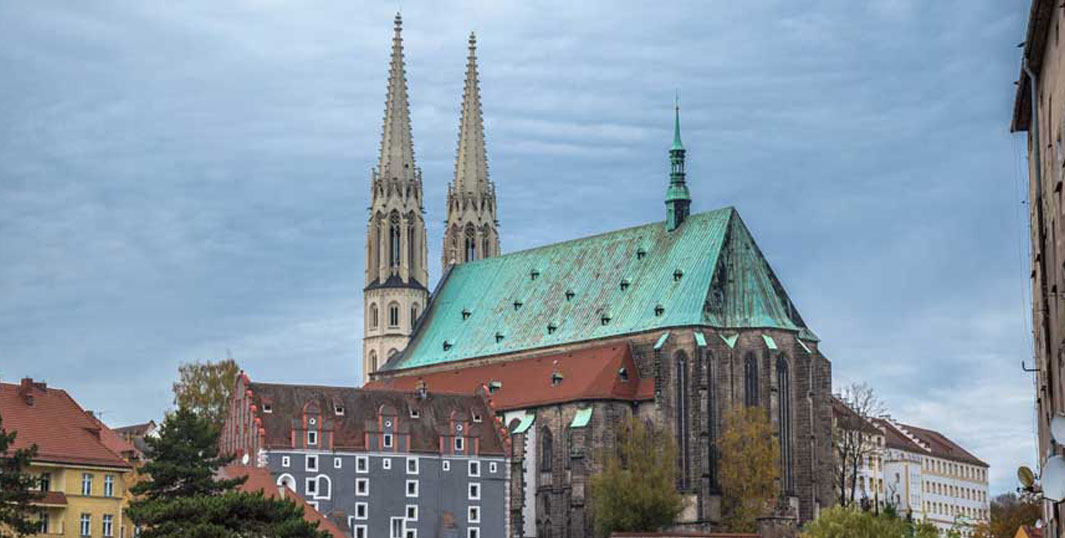 There is no shortage of picture-perfect views in Görlitz...
Germany's easternmost city does not often make the headlines. When it does, it is usually because of its impressive architecture. That was reason enough to visit this city on the River Neisse. Deutsche Bahn handed over the route to Cottbus and Görlitz long ago, so the entire service is now operated by the East German Railway. The train to Cottbus was a completely packed double-decker, accompanied by more than an hour of rustling paper bags and children's shouting. From Cottbus, I continued to Görlitz on a rail bus, passing derelict houses and abandoned industrial sites – a truly depressing sight. Interesting intermediate stops such as Weißwasser and Horka helped broaden my geographical knowledge. Along the route, all stations were also signposted in Upper Sorbian, a recognised minority language in Germany. A journey of 2 hours and 40 minutes for just 200 kilometres made for a long trip. Görlitz railway station surprised me with its size. I would not necessarily have expected that in a city of 55,000 inhabitants. I was also a little surprised that the city has a tram network. On the way to the Old Town, I passed magnificent, extensively renovated buildings from the Wilhelminian era. Among all the restored buildings, there are repeated contrasts in the form of unrestored houses with boarded-up windows. Their condition gives a good idea of what Görlitz looked like shortly after German reunification. It is all the more remarkable to see how much has changed for the better over the past 25 years. Unfortunately, investors have still not been found for every building in need of renovation, and decay continues unchecked in some places. As you approach the Old Town, the architecture changes from Wilhelminian-era buildings to Baroque and then medieval structures. In Görlitz, one architectural highlight follows another. The city is a mix of Prague, Wrocław and Krakow. It would take several days to explore everything properly; there is an enormous amount to see. For its population, the city feels much larger. It is easy to explore on foot, although distances are greater than expected. There were not many tourists around on this autumn day. Most visitors seemed to come from neighbouring Poland. Many restaurants and pubs on the western side of the Neisse were entirely Polish-owned or staffed by Polish employees. Görlitz, too, has struggled with a steady loss of population since reunification. The city has lost more than 22,000 residents since then because of its difficult economic situation and the associated decline in births. The structurally weak Lusatia region will continue to drive emigration in the future. Tourism is about the only sector booming. Even so, Görlitz remains relatively unknown among international visitors.
The Obermarkt and Untermarkt form the city's historic centre. Nearby are the Nikolaizwinger and the Church of St Peter and Paul. Behind the church, the road slopes down to the Old Town Bridge. Opened in 2004 as a pedestrian-only bridge, it connects the western part of Görlitz with the eastern part, which now belongs to Poland and is called Zgorzelec. Many day-trippers cross from east to west and back again. German visitors often take the opportunity to buy cigarettes or alcohol at lower prices. Hotels, cafés and restaurants line the entire Old Town. Görlitz is not, however, overrun by tourist crowds. There is also plenty to discover beyond the historic centre. Numerous side streets are lined with beautifully renovated old buildings. Simply wandering around is well worthwhile. Every now and then, traces of a long-defunct state can still be seen. The former VEB Kondensatorenwerk on Uferstraße is an impressive reminder of that era. Other industrial ruins are scattered throughout the city. There are plenty of things to do outside the centre of Görlitz as well, including the zoo, Weinberghaus and the Neisse Viaduct. The Landskron brewery offers guided tours on several days each week through its impressive industrial monument. If you are lucky, you may even witness a film shoot. Görlitz is a popular location for the film industry.
Conclusion: You should allow plenty of time to discover Görlitz. One day is not enough for a city with so many sights. Visitor numbers are currently rising, but the city is still a long way from the mass tourism seen elsewhere. Having escaped wartime destruction, Görlitz offers architecture from many different periods and gives an impression of what many German cities must have looked like before the war. A visit can easily be combined with a shopping trip to Poland. Görlitz is definitely worth a visit, even if the city seems deserted after 10 p.m.


