



- Details
- Hendrik Lorenz
- Category: Blog
- Read Time: 6 mins
- Hits: 215
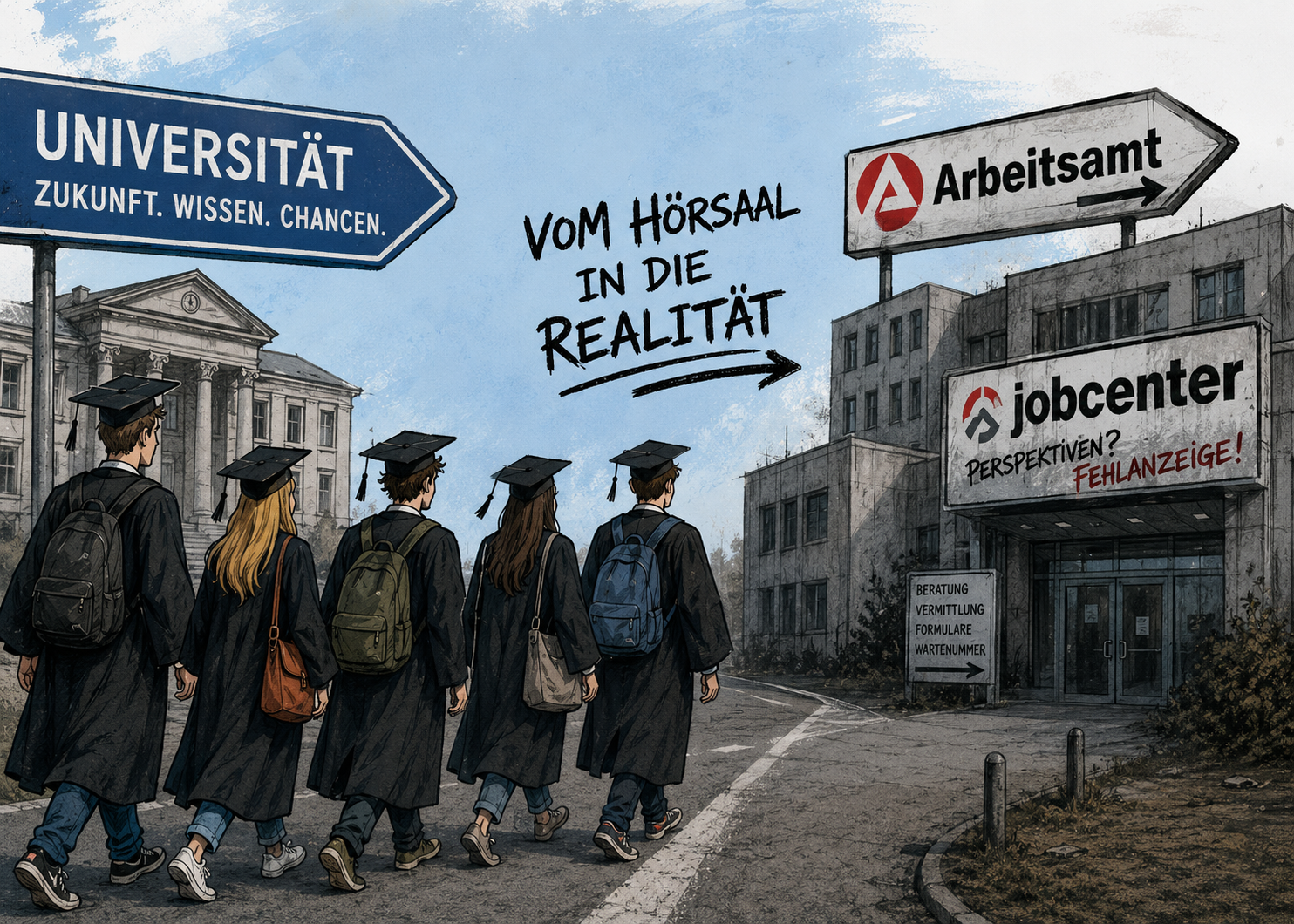
On LinkedIn, I came across a complaint post by a young graduate who was extremely upset that, ten months after graduating, she still had not found a job. Despite sending hundreds of applications, she keeps receiving rejections; the Job Centre is providing no financial support, and she has to apply for positions that do not appeal to her. Naturally, this is an unsatisfactory situation. At the same time, reading the post gave me the impression that several expectations about university, entering the workforce and the labour market are colliding here – expectations that perhaps need to be viewed a little more realistically. However difficult the situation may be, the struggle to get started in working life is by no means a new phenomenon, contrary to what was claimed. Even 30 years ago, a university degree was no guarantee of entry into one’s dream profession, or even into the labour market at all. There was a reason for the exaggerated saying back then: “From the lecture hall to the welfare office.”
Professional experience has always been a decisive factor. Someone fresh out of university is initially at a disadvantage compared with applicants who have already gained several years of practical experience. What has changed, however, is the number of university graduates and therefore the level of competition. Today, far more young people complete their Abitur and go on to university than in the past. At the same time, requirements and qualification levels are not necessarily perceived in the same way they were several decades ago. Anyone who therefore expects a degree to provide an automatic, direct route to an attractive career can be in for a rather unpleasant surprise on the labour market. Added to this is the fact that young people are sometimes given a very unrealistic picture of the labour market – by the media, schools and the government. This is reflected not only in career expectations but also in very practical matters such as salary expectations, working hours and willingness to be flexible about employment opportunities. In some cases, applicants’ expectations are remarkably far removed from what the relevant labour market actually offers. A degree alone is no free pass to the salary, working hours, location or company of one’s choice. The much-invoked “skills shortage” (which, in my view, never really existed and was always just an excuse to justify certain political decisions) does not mean that every graduate automatically gets a suitable job. There may be shortages in certain sectors and regions while, at the same time, there is an oversupply of people with other qualifications. The blanket statement “Germany needs skilled workers, so every graduate must be able to find a job without difficulty” is therefore extremely unrealistic. Before starting a degree, people should also consider what happens if the great career does not begin immediately after graduation. That includes familiarising themselves with the German welfare system. When are you entitled to unemployment benefit I? When is the Job Centre or employment agency responsible? What conditions apply to benefits, and what role do existing assets play? These are not obscure rules; the information has been publicly available for decades. There are certainly ways to protect one’s assets from state access if appropriate arrangements are made in good time. Entirely legally. Anyone who fails to do so simply has to live with the consequences.
I know the situation from personal experience. In my case, it was the social welfare office that was responsible back then. I, too, was “officially” required to apply for jobs that had little or nothing to do with my actual qualifications or profession. However, with completed vocational training, several years as a journeyman and a completed university degree, it quickly became clear that nobody was going to hire me as a sausage vendor, because employers had to assume I would leave immediately if a suitable opportunity came along. Some employers also considered it cheeky that I had applied – not because of me personally, but because the state had forced them into such a completely pointless exercise. Ultimately, I never had to accept a job below my qualifications (not because I was unwilling to do so); it simply never came to that. The social welfare office was also completely overwhelmed by my application records and never got back to me, despite threatening: “We don’t see why you shouldn’t be working.” I therefore took a pragmatic view of that period of unemployment. I wrote applications, introduced myself to companies and eventually jokingly referred to it as “application tourism”. I travelled all over Germany, fully aware that many of those applications had little chance of success. At least I was able to practise job interviews and get to know Germany, while the companies covered the travel costs for the interview appointments. Looking back, those twelve months of unemployment were therefore by no means twelve wasted months, apart from the impact on my pension contributions. There were also some truly bizarre experiences during my interviews. The strangest interview took place in Traunstein at a mechanical engineering company. As soon as I arrived, I was handed several hundred euros in cash for travel expenses and incidentals. Then I sat opposite three older, grey-haired gentlemen who had obviously already been through a complete marathon of interviews. Application folders were piled up on the table in front of them, and they seemed to have long since lost track of who was who. Accordingly, I was addressed by the wrong name several times. But the highlight was still to come: one of the three men simply fell asleep during my interview. And not quietly or discreetly – he was snoring. In Gütersloh, by contrast, the interview turned more into a political loyalty test. In Kempen, I was invited twice, after which I heard absolutely nothing for months. Eventually, an invitation to a third interview actually arrived, as though nothing had happened in the meantime. And then there was the interview in Stendal. Opposite me sat a rather portly gentleman who was happily smoking his cigar and blowing the smoke straight into my face. At some point he asked about my salary expectations. After I stated my figure, his dry response was: “I’ll offer half.” That, too, was a form of negotiating culture. I was also repeatedly struck by companies that apparently did not know there was a legal provision governing applicants’ travel expenses. In principle, anyone who invites an applicant to an interview must cover the necessary travel costs, unless reimbursement has expressly been excluded in the invitation beforehand. A few companies came unstuck over that, and I took pleasure in explaining the rules to them.
Rejections after university, vocational training or in general can be frustrating. But that does not automatically mean that the system as a whole is failing today, or that a degree creates an entitlement to a particular profession, salary or career. Beginners have always had a harder time. Ultimately, realistic expectations, flexibility and a willingness to take detours at first are what matter when trying to find a way into working life.


 1. Regarding the sound ...