


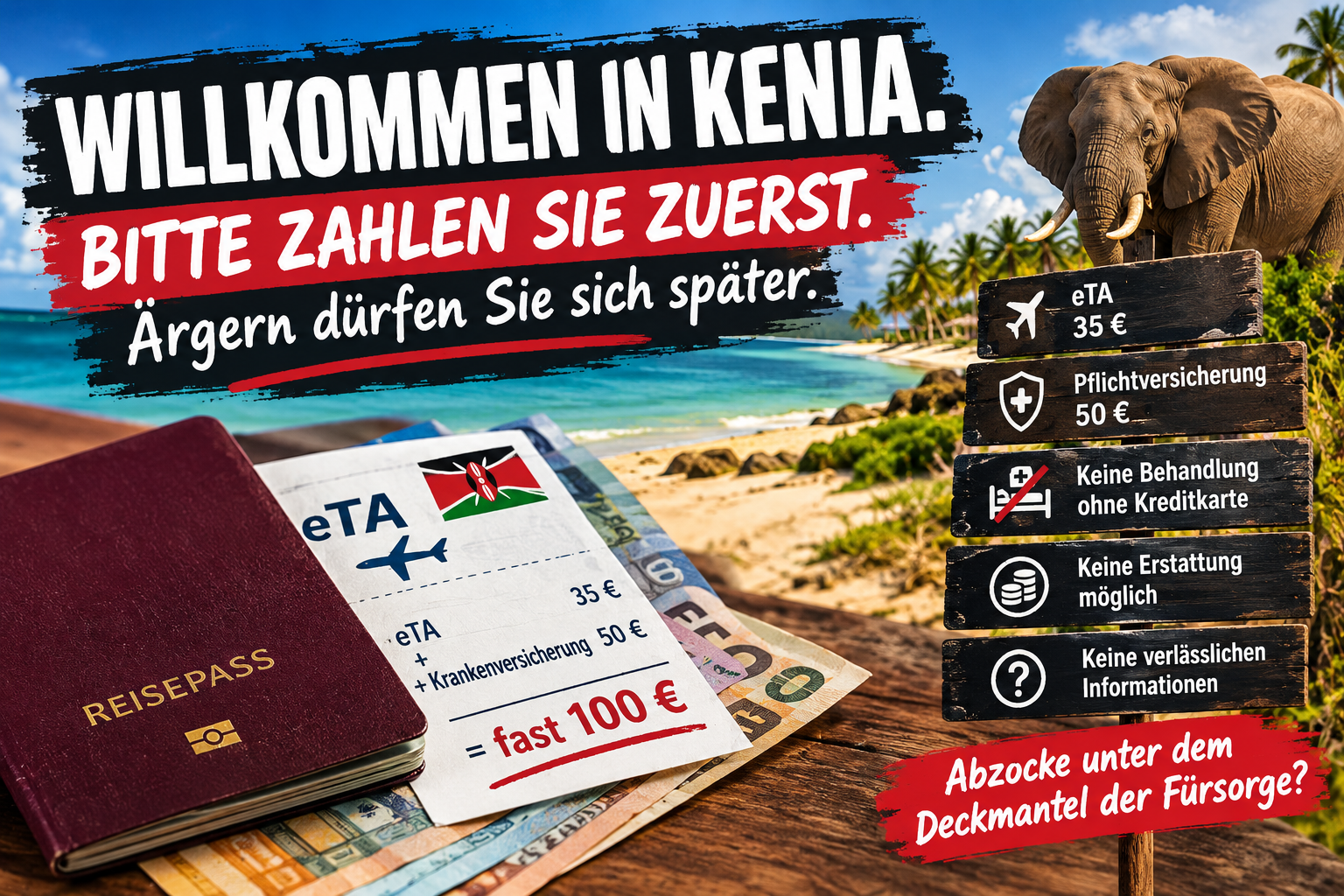
The electronic travel authorisation (eTA) has long been part of everyday life in Kenya. It costs around €35. To me, it is less a useful administrative service than an additional admission fee — and a recurring source of frustration. Fill in the application, pay, wait and hope everything works out in time.
I would like to spend another holiday on Kenya's south coast in December. The trip has already been booked. Now, at short notice, a compulsory local health insurance policy has been added. Had I known about this before booking, I would seriously have considered choosing another destination. My point is not that tourists do not need health insurance. Good international travel health insurance is essential. What I criticise is the requirement to take out an additional, specific local policy, even when comprehensive insurance cover is already in place. The compulsory policy costs around €50 for 90 days, with a coverage limit of US$50,000. My international travel health insurance, by contrast, costs only €20 a year and offers unlimited worldwide cover. Nevertheless, it apparently is not accepted as an alternative. So I have to pay extra even though I am already insured — and, as I understand it, my existing cover is even more comprehensive. To me, this is a hidden increase in the cost of entry. The eTA fee of €35 rises to around €85 when the insurance is added, before I have even set foot in the country.
The additional insurance is supposed to protect tourists. But what concrete benefit does it offer me? An additional third-world insurance policy alone does not improve medical care. What matters is whether travellers can get help quickly in an emergency and whether the costs are reliably covered. Do I have to produce my credit card before receiving treatment despite having local insurance? How easy is it to get reimbursed? And can everything be handled without difficulty after returning home? I have no clear answers to these questions. That is why the compulsory policy has not convinced me as a sensible protective measure so far. Insurance must help in an emergency. Its benefits should also be accessible without unnecessary obstacles.
I get the impression that extra money is being demanded from tourists under the guise of looking after them. I cannot judge whether this is driven by economic interests, political decisions or other motives. What remains difficult to understand, however, is why my existing insurance cover should not be sufficient.
‘Tanzania and Zambia do it too!’ I can no longer stand hearing that argument. My answer is simple: that is precisely why I have never travelled there. Just because other countries introduce similar fees or regulations does not automatically make a rule sensible or fair. What matters is whether it is understandable and offers a genuine benefit. After all, travellers are free to decide where to spend their money. Competition for holidaymakers is not a one-way street. Tourists already spend plenty of money locally: on hotels, restaurants, excursions, safaris, drivers and transfers. Local businesses benefit from this. It secures jobs and income. I am happy to pay for good services and worthwhile offers. What I cannot accept is a constant stream of new compulsory charges without any recognisable added value.
Kenya's information policy also disappoints me. I searched the German Federal Foreign Office and the Kenyan embassy for information about the new entry requirements. I did not find any genuinely helpful guidance. Clear and reliable information is particularly important when changes are introduced at short notice. Travellers need to know in good time what costs they will face, what insurance conditions apply and what benefits they can expect. This also includes a comprehensible explanation of why existing insurance should not be sufficient.
Instead, important questions remain unanswered, while the additional costs are certain. This is frustrating and does not leave a good impression of how Kenya welcomes its guests. Despite my annoyance, I will travel to Kenya in December. I am looking forward to the south coast, the scenery and the people. Of course, I will also spend money there and support the local economy. But I am not a walking cash machine. It cannot be right that more and more fees and compulsory contributions are charged before arrival. The eTA, the additional insurance and the poor information policy add up to an overall picture that has little to do with genuine hospitality.
Around €85 for the eTA and compulsory insurance before I have even set foot in the country — I find that simply outrageous. It is not just about the amount. It is about the principle: additional costs, questionable benefits and too little transparency. I am not questioning the need for adequate insurance cover or sensible safety measures. But I do expect understandable rules, proper consideration of existing insurance policies and clear information about costs and benefits. Holidays are voluntary. Anyone who keeps making travel more expensive without offering any recognisable added value should not be surprised if guests eventually choose another country. Hospitality does not begin only when you arrive. It begins with the question of how welcome a guest feels on the way there.



 1. Regarding the sound ...


Add comment