


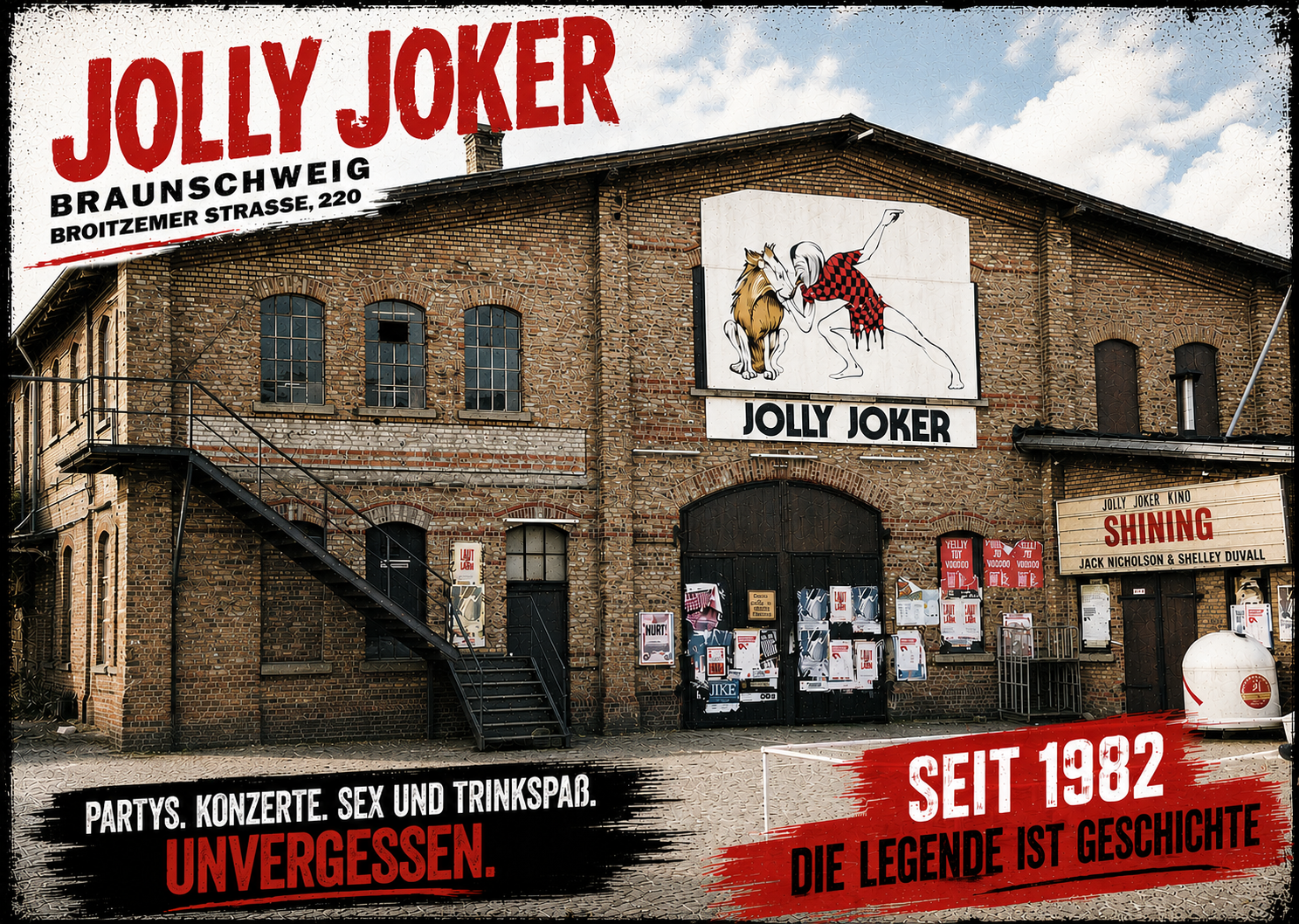
Whenever I asked someone in the 1980s what they thought of the large Jolly Joker nightclub on Broitzemer Straße in Braunschweig, I always got the same answers: filthy, disgusting, antisocial. People went in clean and came out dirty. And yet tens of thousands visited this club, weekend after weekend. At times it was so crowded that people could only shuffle through the corridors in huge throngs. But these were precisely the people who were always so negative about it. It reminded me a little of the bands Modern Talking and Scooter. Nobody ever wanted to have listened to them or liked them. And yet recordings by those bands can be found in almost every record collection belonging to people who had previously denied any sympathy for them. After almost 30 years, the final party at the Jolly Joker took place in 2012. Then the lights went out and the doors closed. Bankruptcy. It was a business model from the 1980s that simply no longer fitted the spirit of the 2010s. The operators realised this too late. The consequence was insolvency.
Hardly anyone who was between 16 and 25 at some point in the 1980s or the mid-1990s managed to avoid this place. The nightclub’s catchment area extended from Braunschweig across numerous surrounding districts and as far as the Leine region. The concept was brilliant: an old factory, converted on a shoestring budget, just enough to pass the authorities’ inspections. Cleaning and comfort were cut back wherever possible. In return, admission cost just 99 pfennigs—90 per cent less than other large clubs charged at the time. The nightclub also included a cinema and a basic snack-bar-style restaurant. Food and drink were priced beyond the competition. The idea worked, and the Jolly Joker quickly became a gold mine for its owners. The concept of appealing to as many youth groups as possible also worked. Early in the evening, independent music was played for the subcultures of the day. Later came the regular disco operation for the working-class masses. That way, money could be made at every level. The Jolly Joker in Braunschweig was also a good venue for smaller concerts by non-commercial bands from Germany and abroad. I remember performances by Wall of Voodoo and the Bollock Brothers. The first changes to the place came in the early 1990s. The pay-to-enter cinema became a public movie theatre, which meant that the extreme flow of rowdy and tipsy customers during screenings made watching a film in the picture palace almost impossible. A “Winter Garden” was created where alternative music was played. The chip shop opposite the cinema was turned into another small event area. My last visit to this large nightclub was in 1998. At the time, I would not have thought the club would remain open for another 12 years. Even then, it was becoming clear that its offerings were no longer quite as popular.
After it closed in 2012, a new potential operator was quickly found, and the Jolly Joker was refurbished sufficiently for the authorities to approve its reopening. Five years after the bankruptcy, the old Jolly Joker reopened in 2017 under the name Jolly Time. In reality, the concept and target audience of the new dance venue no longer had much in common with the old days. Almost all that remained was the outer shell of the former factory. Instead of catering to many different tastes and interests, the current spirit of the age had moved in—a scene that can also be found on the main streets of Berlin-Neukölln or Berlin-Gesundbrunnen. Performances by Zahni, Capital Bra, Summer Cem or Kay One instead of Wall of Voodoo or the Bollock Brothers. A shisha bar instead of the Jolly Joker’s “Kohlestäbchen” (chips). 1980s and 1990s parties instead of a St Patrick’s Day celebration. To complete the picture, all that was really missing was a betting shop or the slot machines so popular with a certain clientele. A one-euro shop or a barbershop might also have fitted the concept quite well. Online visitor reviews of the “former Jolly Joker” are quite mixed. Most complaints concern organisation, long queues at the bars and entrance, as well as the staff. Some women complain about the high proportion of migrants and say they sometimes feel harassed by the “new German professionals”. Well, not every statement can be taken at face value, but the posts do give readers a rough overview. Compared with the old Jolly Joker, Jolly Time now seems to be a purely commercial club and nightclub operation.
I loved going to the Jolly Joker. For years. During that time, I (or so it felt) made my way through practically the entire dance temple and always had a good night. To me it was less a nightclub than a social institution, a place where you could simply meet people for a few hours without necessarily taking part in the club scene. You could hardly find the same mix of visitors anywhere else. There was almost never any rejection or door selection outside, unless someone behaved completely out of line. It did not matter what you wore or what you looked like. Hardly anyone was denied entry. A great thing. There is no reason to get sentimental about it, though. The Jolly Joker ceased to exist at the end of the 1990s and, during its final decade, was little more than a zombie venue. I wish the new operator of Jolly Time all the best for the future. It seems rather unlikely that it will make it to another 30 years.
Update: The lights soon went out again at Jolly Time on Broitzemer Straße. The final “party” apparently took place in the first quarter of 2025. The first revival of the old machine factory came to an end quietly and without much fuss. The concept combining a shisha lounge, amusement arcade, 1980s and 1990s parties and a Talahon hangout apparently did not generate enough revenue. Applaus Kulturproduktion GmbH has now taken over the legendary venue and intends to turn it into a dedicated event space. With “Schön & Fröhlich”, another chapter in the history of the old Jolly Joker has meanwhile begun. After its years as a nightclub and cinema, its time as Jolly Time and a long period of vacancy, the building is now intended to be used exclusively as an event venue. Perhaps the old factory has finally found a use that will stand the test of time.


 1. Regarding the sound ...


Comments
Sadly, the place went downhill dramatically over the years. During my final visit, I witnessed two groups of guys—apparently Kurds and/or Turks—getting into a fistfight before eventually pulling knives on each other. By then, the "real" Joker had long since ceased to exist. These two snapshots perfectly capture the sad transformation of what was once a hugely popular hangout for young people and students, attracting visitors from all over the region, into a seedy, run-down dive resembling a shady gambling den.
One of the last highlights was the "Heroes of Woodstock" festival on May 1, 2005, featuring Iron Butterfly, Canned Heat, and Ten Years After. Ten Years After, in particular, were on top form that night.
Thanks for the trip down memory lane!
Well, if you finished your *Abitur* in 1998, that makes you about 10 years younger than me. That means you really missed out on the 'good' times. By the 1990s, the place was already well into its decline. There were no decent events left—just an increasing number of toilets and floors covered in shit and vomit, so sticky that even my heaviest pair of Dr. Martens would get stuck. By all accounts, the current incarnation has perfectly adapted to the modern German *Zeitgeist*: shisha bars, slot machines, and a large dance floor where 'new' German 'men' can grope women without restraint. Back in 1988 at the Jolly Joker, I never could have imagined how drastically—and in such a short time—this country would change. I wouldn't be surprised if the place eventually 'accidentally' burns down. In the long run, this 'new' shisha bar and barbershop setup doesn't have a future either—not once the *Talahons* (troublemaking youths) are gradually deported or end up in prison.
Our group would always split up: some wanted to stay on the main dance floor, while others were drawn to the conservatory or the "Rolling Stone" area. In the latter, I actually managed to get a DJ to play a song I requested—Queen’s "Another One Bites the Dust"—which, as an uncool kid from the sticks, I found incredibly flattering. I also remember a time they screened *Star Trek: The Motion Picture* in the cinema; a friend and I watched, completely spellbound, as the *Enterprise* flew through that swirling green expanse.
We always used to drink Amaretto mixed with apple juice.