


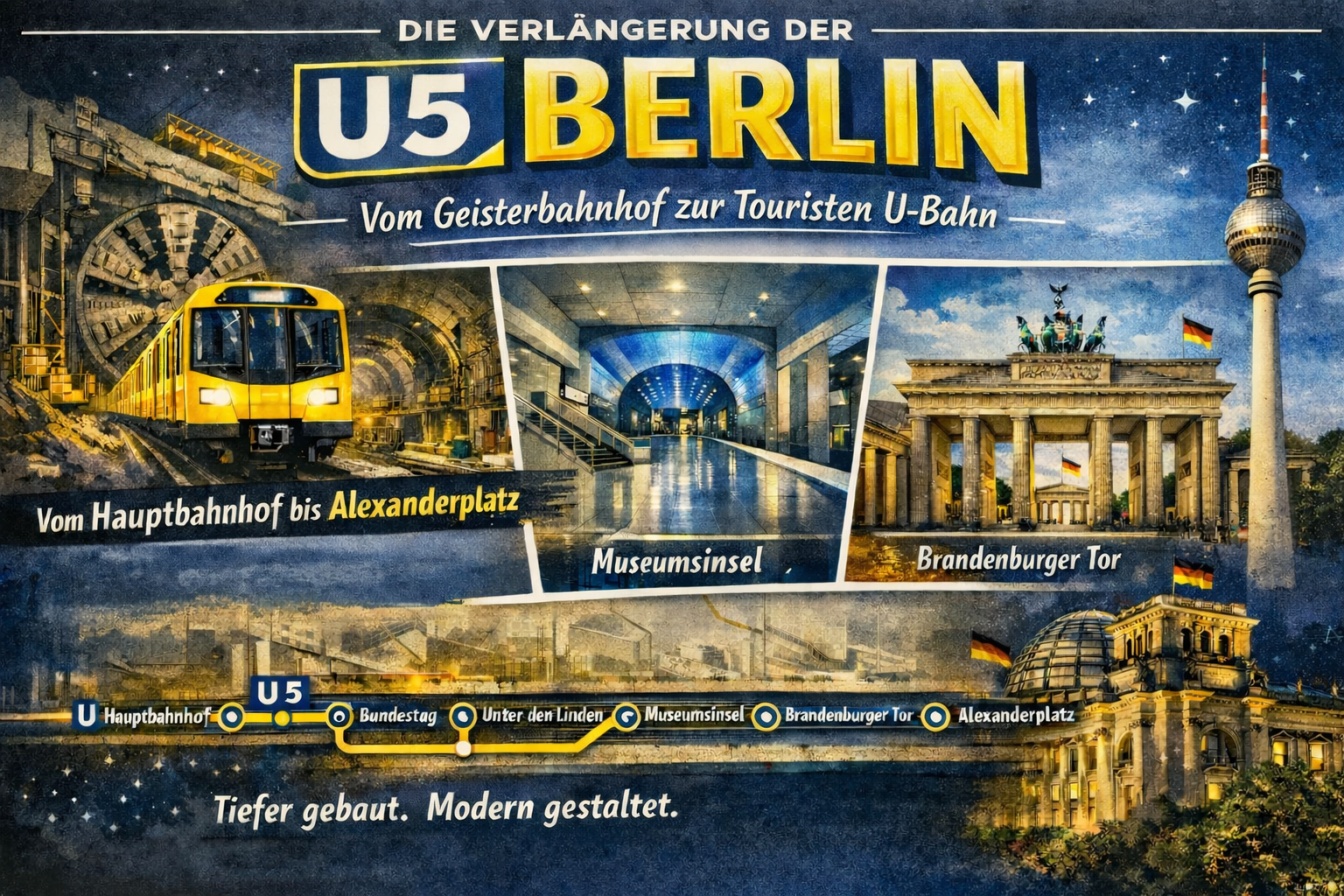
The extension of underground line U5 was one of the capital's most important transport projects since German reunification. Bundestag station was always at the centre of the story. For a long time, it was a symbol of delays. At the same time, it shows just how far ahead the planners were thinking. As early as the mid-1990s, the station beneath the Bundestag was built in shell form. The government district was being redesigned at the time, and the underground railway was intended to follow later. This was meant to avoid costly construction work beneath such a sensitive site. What began as clever planning developed into one of the city's longest-running construction projects.
At first glance, the route from Alexanderplatz to Hauptbahnhof looks short: just over two kilometres. Nevertheless, construction took decades. There were several reasons. One problem was the location. The route runs right through the historic city centre, directly beneath important buildings and streets, as well as existing underground lines. Mistakes were not an option here. Another factor was water. The tunnels pass beneath the River Spree. Berlin's soil is sandy and waterlogged, making construction considerably more difficult. The tunnels had to be secured at great expense. Archaeological finds also played a role. Construction was repeatedly started and then halted. Old structures had to be documented and, in some cases, secured. That took time. Political decisions were another factor. Berlin lacked the money in the 2000s. Construction was stopped or delayed, priorities shifted and projects were reassessed. The logistics were complicated, too. Construction sites in the middle of the city centre are always a major challenge: little space and lots of traffic. Every construction phase had to be planned precisely. All of this turned a short stretch of track into a project that dragged on for decades. After construction was halted, the line remained unfinished for a long time. Bundestag station was not used. The large hall stood empty. No service. No passengers. For a while, the location was used for other purposes, including as a film set. A station without a function.
In 2009, the section finally went into service as a separate line: the U55. Just one station. Hence the nickname “Chancellor's Underground”. Politically significant, but of limited practical use. The connection was still missing. Work on the missing section began in 2010. Construction took around ten years. The new stations are considerably deeper than many older stations. This was necessary because the route passes beneath rivers and existing infrastructure. For passengers, that means longer routes through the stations, with many escalators and deep entrances. On 4 December 2020, the line opened. The U5 was now fully connected from Alexanderplatz to Hauptbahnhof.
At first glance, the new stations look sober. Plenty of concrete, clear forms and large spaces. A closer look, however, reveals the effort involved. The design was carefully thought through and details were deliberately chosen. Light is used selectively. Museumsinsel station in particular is exceptional. Even so, the overall impression is mixed. The new stations are functional and modern, but also very restrained. Some areas even feel cold. Certain sections seem almost sterile. Personally, though, my overall assessment is positive. The stations are well designed and feel high-quality, but in places they lack a little warmth and life.
Five years after the opening of the section from Alexanderplatz to Hauptbahnhof, I finally had the opportunity to visit the new stations myself. The impression was one of quiet. Many stations are empty in the evenings, particularly around Museumsinsel, Unter den Linden and Bundestag. The reason lies in their location. These are tourist areas: lively during the day, quiet at night. There are few residential neighbourhoods and little nightlife. The result is large, silent spaces. Modern buildings, but often without people.
Conclusion:
The underground connection between Hauptbahnhof and Alexanderplatz is a genuine improvement to the city's transport network. The design of the stations is certainly open to debate. It is not really to my taste, and since all the stations serve the entire tourist area, they are still particularly well maintained for now. It is only a matter of time before the city runs out of money and drug dealers, rapists and other criminals take over the new stations as well.





 1. Regarding the sound ...


Add comment