


 The Curonian Spit – a ghost forest...
To complete my visits to the Baltic States, Lithuania was the final destination on the list. It was about time, too. After AirBaltic discontinued its direct flights from Berlin-Tegel, I had to wait for another affordable opportunity. Ryanair has been offering a direct connection to Vilnius for some time, but this low-cost airline famously flies only from Schönefeld. That once again meant spending more time travelling to the airport than to the actual destination.
Vilnius Airport (Vilniaus oro uostas) has good transport connections. Buses (routes 1, 2, 3G and 88) run directly into the city centre. Depending on traffic, the journey takes about 15 minutes. A taxi from Vilnius Airport to the main railway station costs between 15 and 18 euros. The airport is also connected to the rail network. Within Vilnius, public transport is otherwise based on buses. The system is rather confusing and not particularly visitor-friendly. Since the airport is so close to the centre, visitors save a lot of travel time. Vilnius is therefore ideal for a short break.
That becomes clear quite quickly in the city. Although there were no huge crowds of tourists in autumn, they still had a noticeable influence on the cityscape. Vilnius Old Town is similar to those of the other Baltic capitals. It is the only Baltic capital not located directly by the sea. The city is also somewhat hilly and confusing, so getting lost is easy. Between the magnificent buildings, traces of the socialist past appear from time to time. To me, the Old Town of Vilnius felt somewhat overbuilt. It does not have quite the same splendour as the other two Baltic capitals. There is an extremely high concentration of restaurants and cafés, but fewer bars than in Riga and Tallinn. Perhaps that is why drinking tourism is less pronounced here. As in the other Baltic States, supermarkets and similar shops stop selling alcoholic drinks after 10 p.m. Prices in the tourist areas of Vilnius are higher than in Riga or Tallinn. They are not expensive, but neither are they cheap; they are similar to German prices. The artists' district of Užupis is a little quieter, and prices there are not quite as high as in the lively Old Town.


One striking feature is the large number of enormous shopping malls outside the Old Town. They seem completely oversized for a population of just over 500,000. Things become really interesting behind the glittering new buildings. Some streets are unpaved, and people live in dilapidated wooden huts without electricity or running water. In places like these, the surroundings seem more reminiscent of a developing country than a member of the European Union.
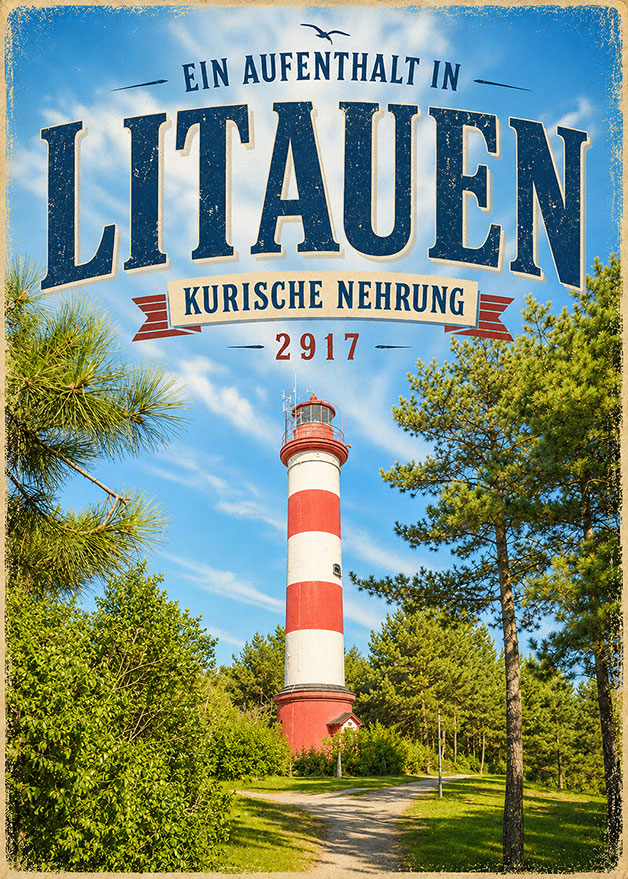
Unfortunately, the weather in Vilnius was dreadful. It was dark during the day and rained almost constantly. These conditions made it difficult to explore the city properly. To escape the gloomy weather, I headed for the coast on my second day in Lithuania – more precisely, to the Curonian Spit. From the port city of Klaipėda (until 1920, the northernmost city in Germany), I took the car ferry to the Curonian Spit. An additional fee had to be paid when entering the Curonian Spit National Park. Then came a drive of about 40 kilometres to the destination of Nida. In autumn, Nida was almost deserted. Many restaurants and shops had already closed. It was hard to imagine that just a few weeks earlier the island had been bursting at the seams with visitors. With its many wooden houses, Nida resembles other historic seaside towns on the Baltic coast. Its forests and dunes make the natural landscape somewhat similar to a North Sea island. The Curonian Spit is ideal for relaxation in October. Only a few groups, mostly from Germany, were still around. The area is perfect for swimming and hiking. Beyond that, there is not all that much to discover because of its size and remote location. Europe's second-largest moving dune, the Parnidis Dune, with its view towards Russia, is very impressive. The Protestant church and its adjoining cemetery, where mostly Germans are buried, are also worth seeing. Boat trips on the lagoon are offered from Nida's small harbour, which becomes a popular place for food and drink in summer. A traditional lighthouse stands not far from Nida on Urbo Hill. At the edge of the Curonian Spit National Park, a viewing platform overlooks a completely devastated forest. The area looks as though it has been hit by acid rain. The damage, however, is caused by the nesting grounds of numerous cormorants, which have effectively covered an entire forest in droppings. After an extremely windy but very sunny day, I drove the 300 kilometres back to Vilnius for my flight to Germany.


Conclusion: I had a lovely few days in Lithuania. Vilnius is a beautiful city, although it does not quite measure up to the other two Baltic capitals and in many ways already feels a little like Poland. I really enjoyed the trip to the Curonian Spit. I had hardly heard of the island before and was surprised by how beautiful it was. Overall, the few days in Lithuania were well worth it. The only disappointment was the bad weather in Vilnius.



 1. Regarding the sound ...


















Comments
Best regards,
Heike