


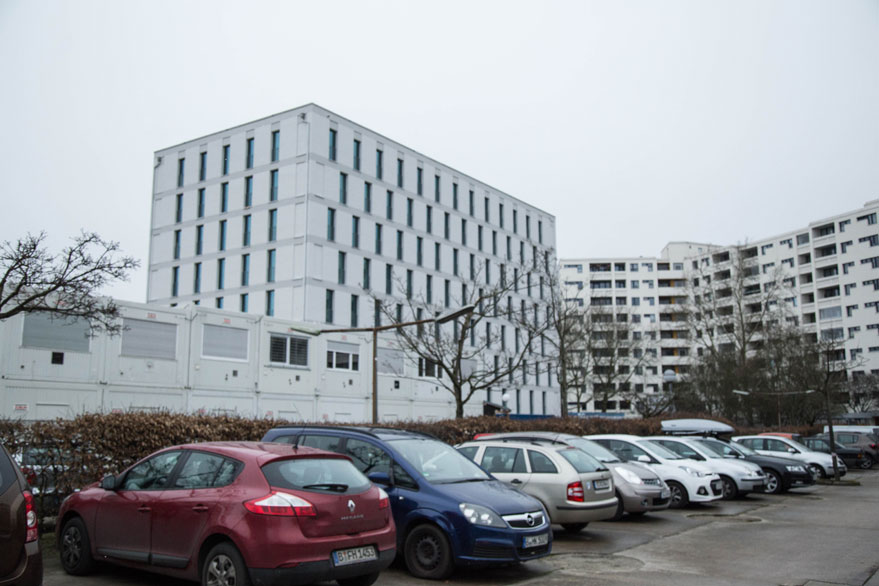
 The time is almost here: the Märkisches Viertel in Berlin is about to gain many new residents at once. Naturally, Berlin's red-red-green Senate has made sure to further expand the colourful life among the high-rise buildings. In order to increase the proportion of residents with a migrant background in this Berlin neighbourhood a little more, 500 so-called “people who have fled” (to use GESOBAU's own words) from the alleged crisis regions of the world are set to enrich the Märkisches Viertel in the future. The city of Berlin is sparing no expense for this: new living spaces are being rapidly built from the ground up for the new academics and skilled workers who will supposedly secure our pensions in the future. Among specialists, the cube-shaped property is also known as an MUF (Modular Accommodation for Refugees). Strange. Something that normally takes decades in Berlin – housing construction – can suddenly be done very quickly. The stated aim is:
“To provide refugees with decent accommodation.”
That is what GESOBAU says on its website. Understandable. The skilled workers should, after all, be comfortable, given the value they are expected to contribute to the country.
To avoid stirring up envy among the people who have lived here for longer, GESOBAU confidently announces:
“The aim is to create more regular housing for all population groups in Berlin in the medium term.” It goes on: “At a later date, the apartments will be available as ordinary housing to all population groups.”
That is very commendable and selfless of GESOBAU. It has not forgotten the other “population groups”. But there is a catch: as we all know, large numbers of “refugees” are currently arriving in the country. At the current rate, whenever an apartment becomes available, more “refugees” will move in. And if there is no change in policy, this will continue for the next 20 years. In other words, the apartments will not be available on Berlin's open housing market to the tens of thousands of people from other population groups who are looking for housing. Even if they were, the building would probably first have to be completely stripped back and renovated before being released for general use. In the worst case, complete demolition could be necessary. What GESOBAU says about this is therefore completely unrealistic. Anyone who has looked at the buildings will quickly realise that these cubic structures are hardly likely to create a cosy living environment. Reuse is desirable, but probably not feasible with this design.
Residents of the Märkisches Viertel are also asking another question: who will move in there? GESOBAU naturally has a suitable answer for that, too:
“Families with children, single people and shared apartments will find a new home here.”
At first glance, that sounds like a lovely, harmonious world and pure social romanticism. The fact is, however, that only a few families are among the people described as “refugees”. Young male economic migrants are the rule; women and families are more the exception. And what about the ethnic backgrounds of the new neighbours? What happens if they are not compatible with the people who have lived here for longer? The Märkisches Viertel is home to many different nationalities. Conflicts are therefore inevitable. More like a source of tension than a social enrichment. As if the Märkisches Viertel did not already have enough problems. Here, too, GESOBAU knows how to reassure the public, gloss over everything and paint a rosy picture. A culture of welcome, with get-togethers and meet-and-greet parties. It is hard to believe that the arrival of more people from the world's crisis regions will improve quality of life in the Märkisches Viertel. So far, however, things have remained quiet around the refugee accommodation in the Märkisches Viertel. The building, with its nicely fitted kitchens, has been ready for occupancy for months. Yet no residents have arrived so far. The reason: no operator has been found for the refugee accommodation. That is unlikely to bother anyone in the neighbourhood. But perhaps this is only the calm before the storm.
Update: Apparently, the first residents moved into the accommodation in mid-December 2018. It will now be interesting to see how the newcomers integrate into the Märkisches Viertel.



Comments