


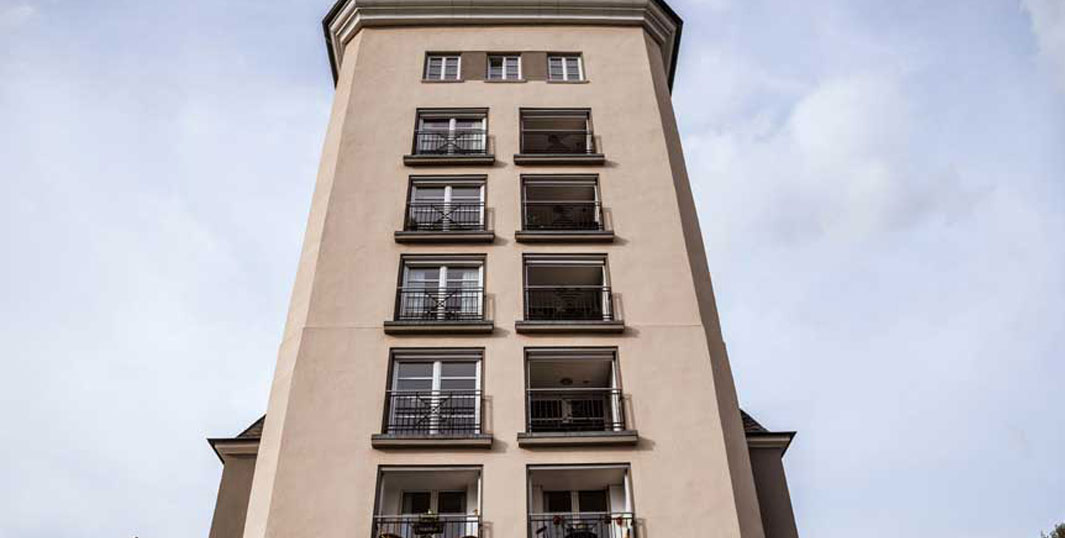
 Once an air-raid shelter, now an exceptional residential building.
Even the city with the world’s longest bar counter was not spared Allied air raids during the Second World War, which began in 1940. To protect workers and civilians, numerous above-ground bunkers were built at locations throughout Düsseldorf. Some still shape the cityscape today and continue to serve a variety of purposes. Unfortunately, some of these witnesses to history, cast in reinforced concrete, have had to make way for other plans.
One of the buildings currently affected is the attractive bunker on the corner of Kölner Landstraße and Reusrather Straße. The wrecking ball is now doing its ruthless work there. Built in 1942, the building was used by an artists’ collective until 2013, when the group was eventually forced out through legal action. Demolition was scheduled to be completed in the summer of 2017, with apartments planned for the site. Once again, a historically significant building – apparently an eyesore to some because of its past – is being sacrificed for developments that could just as easily have been built elsewhere.
Look carefully and you will find another bunker on the corner of Kölner Landstraße and Reusrather Straße. This one has since been converted into a residential building and is not immediately recognisable as an air-raid shelter. The depth of the windows and entrance doors, however, clearly reveals the original purpose of the structure. Another above-ground bunker on Kölner Landstraße, near Burscheider Straße, is currently being developed and is covered in scaffolding and sheeting.


One of Düsseldorf’s two so-called “Winkel towers” stands on Lierenfelder Straße. The name has nothing to do with angles: this type of bunker was named after its designer, Leo Winkel, who wanted to minimise the target area by using a cigar-shaped design. The curious thing about the Winkel bunker on Lierenfelder Straße is that it is located inside another building. Artist Anna Löbner gilded the tip of the bunker, which now shines across the entire Lierenfeld district.
A few metres farther on, in the Heimgarten housing estate on Gatherweg, built in the 1920s in the traditional Heimat architectural style, stands another above-ground bunker. This well-preserved stronghold now serves as a rehearsal space for musicians, as so many similar buildings do. Its sheer dimensions still provide a sense of protection for the Heimgarten estate. Also in Lierenfeld, at the corner of Erkrather Straße and Bermeshau, there is an almost identical above-ground bunker. It is apparently used by a company as a warehouse or perhaps as another music bunker.


A particularly attractive above-ground bunker, which is now barely recognisable as such, can be found at Kaiserswerther Markt in Düsseldorf-Kaiserswerth. It was built in 1942 and converted into a residential building in 1955. The apartments were subsequently rented to employees of the federal and state governments. The federal government has since sold the bunker; it was extensively refurbished to a luxury standard and the apartments were sold as condominiums.
The absolute highlight among Düsseldorf’s bunkers is the Bunkerkirche in Düsseldorf-Heerdt – probably the most solid church in the world. The bunker was originally built in the shape of a church to make it an unattractive target. The camouflage did not work: the building was hit several times, but survived without damage. Genuine German engineering. After the war, the air-raid shelter was actually converted into a church by the St. Sakrament parish, and it continues to serve that purpose to this day.





 1. Regarding the sound ...


Add comment