


- Details
- Hendrik Lorenz
- Southeastern Europe
- Category: Yugoslavia
- Read Time: 9 mins
- Hits: 61401
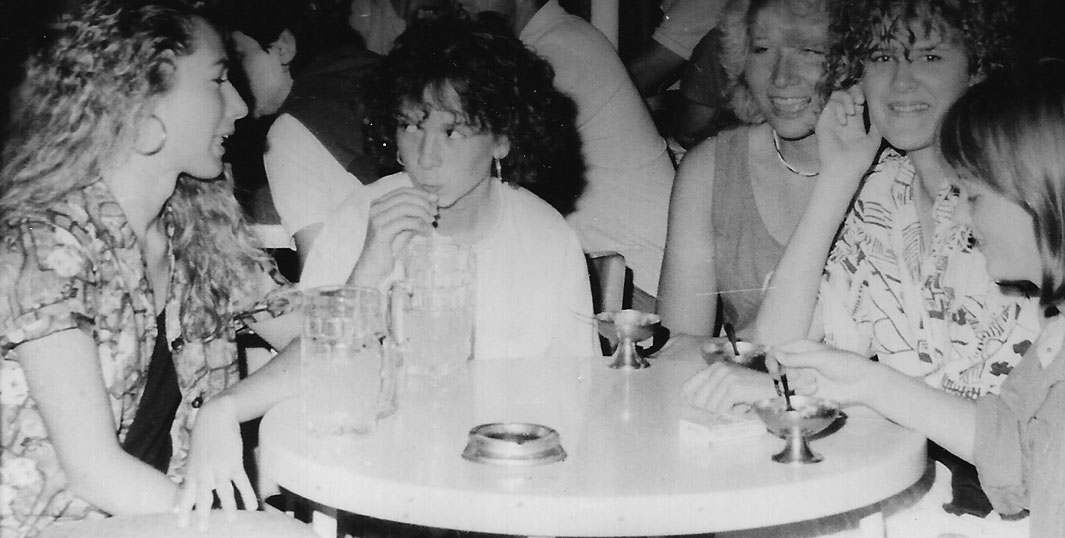
With Birgit Garbers from Nienburg in Rovinj – my first evening with so many women...
To avoid becoming depressed from sheer boredom during the summer holidays of 1987, I was lucky enough to have Hanne-Lore Lorenz treat me to a holiday. Probably not entirely without self-interest. I am sure that once the rascal was out of the house, life would become a little more pleasant for a mother. The destination was Yugoslavia. At 17, I had heard of the country, of course, but I first had to consult an atlas to find out exactly where it was. Until then, I had really only known Yugoslavia through the band “Laibach”, whose music was played over and over in the independent clubs in Braunschweig at the time. Anyway, off to the Eastern Bloc. The trip was organised by Sportjugend Niedersachsen. My brother drove me to the Hanover central bus station in a battered yellow Golf Mk1. We made it just in time. I ended up sitting in a small bus by the emergency exit. My neighbour was a fat chain-smoker. After almost 20 hours in a smoke-filled bus, we finally arrived. At first, I had no idea exactly where I was. In the 1980s, there were very few ways to find out about another country or holiday destination in advance. My first impression was overwhelming: brilliant blue skies, a beautiful sea and cicadas chirping deafeningly in the bushes.
The group was split up. Three or four people were assigned to each room in a socialist-looking concrete block, which the Sportjugend leaders called a “pavilion”. At least there was a lovely view of the Adriatic. There was no conventional beach. Instead, there were plenty of rocks where holidaymakers lounged on their air mattresses. The water was so clear that you could see right to the bottom. Sea cucumbers were everywhere (the Sportjugend report from 1989 refers to sea urchins). Some people pulled these creatures out of the water while diving, just for fun. Nobody had any use for them, though. The Adriatic was also very pleasantly warm. There was a boat rental nearby. One evening, a few people from our group had the brilliant idea of stealing a boat. They sailed to a nearby uninhabited island. Unfortunately, the boat capsized on the way back. The owner was understandably not particularly pleased the following morning. The weather was beautiful every day in July. There was not a single rainy day. It was extremely hot. And yet the holiday destination was only about 1,200 kilometres from home. It still felt like another world.
Meals were served in a central building at the accommodation. It had more of the atmosphere of a company canteen, where you had to pay with meal tokens. The complex was clearly getting on in years and was very basic. But none of that mattered. Sun, sea and holidays were all that counted. Getting to Rovinj required a short walk. In the high temperatures, that walk could feel rather long. There was a bus service, too, but we never used it because the buses ran so infrequently and there was no proper timetable. Even in 1987, Rovinj had a breathtaking old town. Fortunately, it survived the Yugoslav Wars largely unscathed. The historic centre lies on a peninsula. At the harbour back then, there were mainly fishing boats and excursion vessels. The large, expensive yachts that dominate the harbour today were nowhere to be seen. There were plenty of good, inexpensive restaurants throughout the old town. A short walk into the hilly hinterland outside the historic centre was also worthwhile. There you could find rustic restaurants serving good food. Rovinj did not have any major tourist attractions, but there was never a dull moment. One unforgettable experience was a trip along the coast on a pirate ship. Fish were grilled on board, and wine and other drinks were served. During a stop in the Lim Channel, we were even allowed to jump straight into the crystal-clear water from the boat’s tall mast. Great fun. I also remember the day trip to Venice from Pula. The three-hour crossing of the Adriatic included food and entertainment, and there was plenty of time to explore Venice itself.
In the 1980s, Yugoslavia was also a popular holiday destination for privileged East German citizens. On the beach, we met a group of young men from an East German boxing club. We got on very well with them. Together, we even hatched plans to smuggle a few of them onto our bus for the return journey. Fortunately, it remained just an idea. Border checks in 1987 were still very thorough.
Searching for the accommodation from back then
In my search for the exact location of the accommodation, I have now come across an interesting source. In an old advertisement from 1987, Sportjugend Niedersachsen promoted two summer trips to Rovinj. The second offer ran from 2 to 18 July. The journey was by bus from Hanover. Accommodation and full board were included in the price of 696 Deutsche Marks. That was exactly the trip I took. The precise name of the accommodation is particularly interesting. The advertisement refers to the international youth centre “obalah mladih”. At last, I had a concrete name connected with that trip. The other details also match my memories: Rovinj as the destination, the bus journey from Hanover and accommodation with full board. During further research, I came across Škaraba near Rovinj. An international youth centre was established there as early as 1962/63. Croatian sources refer to it as “Međunarodni omladinski centar Škaraba”. Former visitors describe a large holiday complex with different types of accommodation, shared rooms and a central canteen building. These descriptions are quite close to my own memories. Another clue strengthens this theory. In a German-language internet forum, a woman reports that she stayed in Škaraba with a youth group from Hanover in 1988. She describes small pavilions with shared rooms, a communal canteen and other leisure facilities on the grounds. That sounds very much like my own experience a year earlier. The location also fits my memories. The complex stood on a hill, just a few minutes’ walk from the sea. The available sources do not prove that the youth centre named “obalah mladih” in the advertisement was actually the international youth centre in Škaraba. However, the similarities are remarkable. I now consider Škaraba the most likely location of the accommodation from that time. It is also interesting to see what eventually happened to the complex. A former visitor reported finding it badly vandalised as early as 1995. Apparently, the youth centre had seen better days after the break-up of Yugoslavia. In the early 2000s, the bungalows, reception and central building were finally demolished. A Croatian report from 2006 describes the site after the demolition work. According to the report, only the restaurant by the sea remained. I have not yet been able to find out exactly when the youth centre ceased operating. It is remarkable, though, that I was still able to spend a holiday there in 1987, only for the complex apparently to be left to decay a few years later. After almost 40 years, a vague memory has turned into a fairly concrete lead. The search is not quite over yet.
Conclusion:
The holiday in Yugoslavia was one of the best trips I have ever taken. I remember the entire time on the Adriatic coast extremely fondly: sunshine, crystal-clear water, great excursions, new acquaintances and plenty of youthful mischief. Unfortunately, prices are no longer as attractive as they were back then. These days, the same budget could even buy a holiday in the Caribbean – all-inclusive, too. Nevertheless, Croatia is still on my list of places to visit. I just need to find the right time. Perhaps further research will also help me finally settle the last open question: was our accommodation really the international youth centre in Škaraba? The evidence now points strongly in that direction. After almost 40 years, it would be wonderful to solve this little mystery once and for all. My thanks go to the Niedersächsisches Institut für Sportgeschichte e.V. and to Mr Völkening, who provided me with advertisements and records from that period. The attached pictures have been digitally remastered. They are all scans from negatives, as no original prints remain today.


