


- Details
- Hendrik Lorenz
- Category: Blog
- Read Time: 9 mins
- Hits: 4035
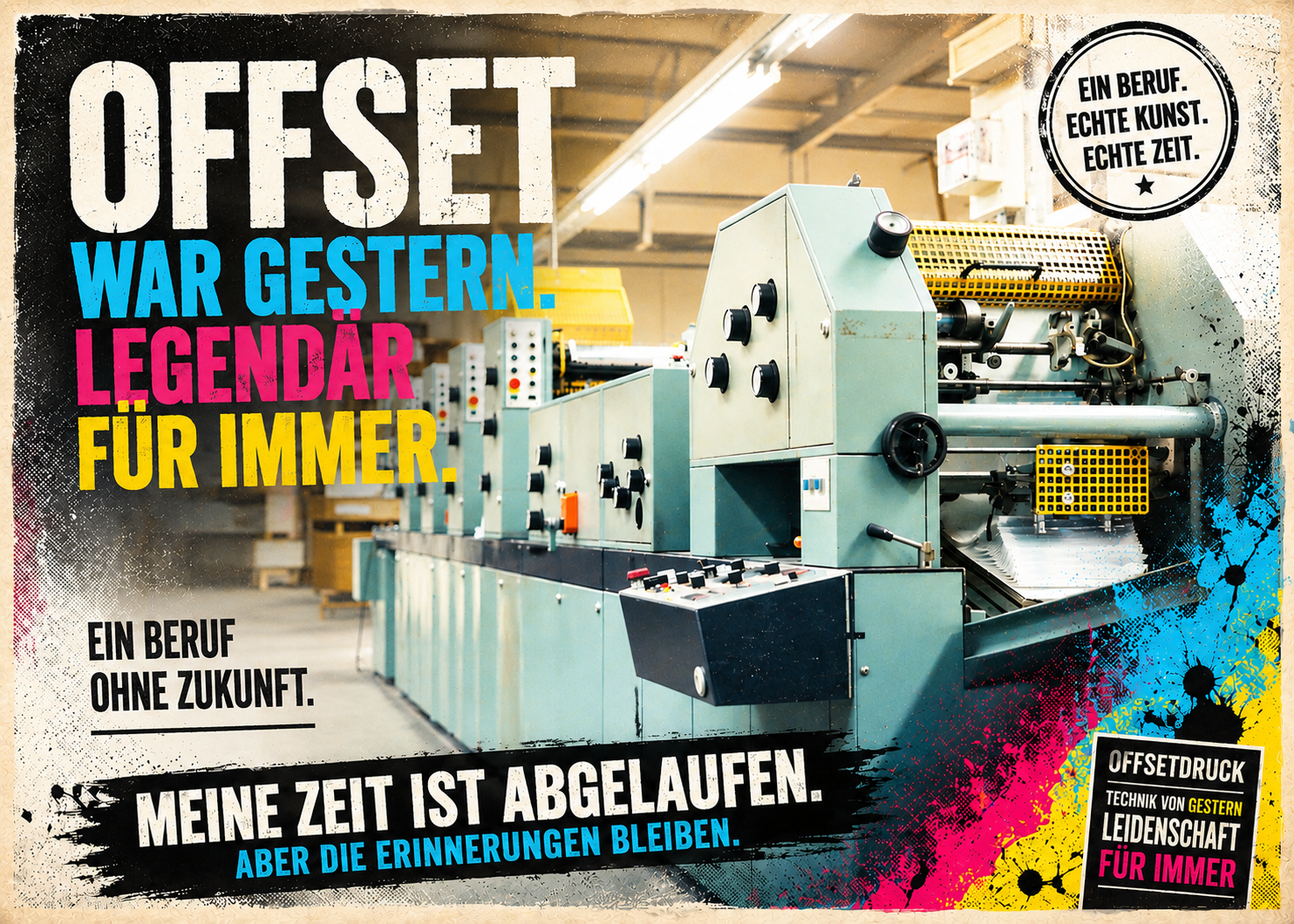
It was 1987. At school, the first pupils were leaving after Year 9. I had no intention of leaving school in Year 9, but I knew that a year later my own time in the school system would come to an end, at least for the time being. The educational institute made a great effort during this period to steer its pupils towards a future career. Visits from institutions of the employment office, as it was then known, were a regular occurrence. Somehow, though, I could not get excited about any of the professions available to me with my qualifications. It was not until shortly before completing Year 10 that I made up my mind: printer. At the time, it was still a respected profession in which one could earn relatively good money, at least by the standards of a basic apprenticeship. If you search for the job title on Google today, the first page includes articles with headlines such as “Careers with no future: jobs threatened with extinction”. That is indeed the reality today. Things looked rather different in 1988. Although demand for traditional printed matter was already declining, there were still a number of training establishments. Even then, however, they were few and far between in the Braunschweig border region, and there was a considerable surplus of applicants for very few positions. After failing to make it through the final round of the application process at two or three reputable printing companies, I found myself in a rather awkward position shortly before finishing Year 10. To put it plainly: I had not found an apprenticeship. So I had already registered for another year at school as a precaution, when the unexpected happened. I can no longer remember who gave me the tip. Someone told me that a small printing company in Vechelde was still looking for an apprentice after its previous candidate had turned out to be colour-blind. I went along, and at the very last minute I got the apprenticeship. That marked the beginning of three years full of ups and downs, which remain instructive, unforgettable and, in many respects, very enjoyable to this day.
My apprenticeship began in August 1988. I started out on a small American single-colour press (ABDick) without a feeder. It was mainly used to print invitation cards and sympathy cards. It was a real challenge, because the finished products often ended up in the display crooked and badly printed—not without provoking the master printer’s subsequent wrath. Working on a KORD from the 1970s was somewhat easier, but it had its own pitfalls. This was hardly a state-of-the-art printing school. Shortly after I started my training, however, the company acquired a brand-new Heidelberg GTO single-colour press. I only had the honour of working with that machine later on. Quite a few things were genuinely easier with it. For special business cards and letterheads, I even had the pleasure of working on an original Heidelberg platen press. Embossing, die-cutting and perforating were all part of the job. Apart from me, there was the master printer (from time to time) and another temporary printer.
My vocational school was the BBSI on Inselwall in Braunschweig (today’s Johannes-Selenka-Schule). My first day at the institution once again showed me just how poor and outdated Germany’s education system was at the end of the 1980s. The “classroom” looked like a museum. Enormous printing presses from the 1950s—the very machines my father had known during his own training as a positive retoucher—dominated the room. And there was even the same teacher my father had had back in the 1950s. The gentleman was severely overweight and seemed to take an eternity to climb all the stairs from the lower floor of the former hospital to the top. Lessons therefore always started late. By the time the register had been called all the way through, the actual lesson time was practically over. It did not take long for the kindly older vocational teacher to disappear. Officially, it was for “health reasons”. There was no proper replacement for the printing class, though. After numerous cancelled lessons and substitute teachers, a new “teacher” was assigned to us. His only activity was to have everyone present read books for the entire lesson. Cynical, disparaging and sarcastic remarks came free of charge. After several inexplicable assessments, I complained to my master printer. In solidarity, he immediately called the school management. It was a phone call I will never forget, because things got very loud. I had never seen my master like that. He accused the school management of failure, and when he also discovered that our current “teacher” was merely an emergency solution and had trained as a painter, he completely lost his temper. It was not until the end of the second year of training that a professionally qualified vocational teacher, Mr Heitmann, was appointed. Far too late.
At the beginning of the 1990s, another printer was hired full-time at the training company. While I, as an apprentice, had to put up with a 40-hour week, this man worked only 37 hours and enjoyed additional benefits I had never known before, such as holiday pay and a Christmas bonus. When I checked with my fellow printer apprentices at vocational school, it turned out that these benefits were part of the collective agreement of the IG Druck und Papier union. At the tender age of 18, I was hearing about a trade union for the first time. I applied to join, and the workers’ representatives took it upon themselves—unfortunately without asking first; I would have preferred to speak to my master about the unequal treatment beforehand—to ensure that my apprenticeship conditions at the company were brought into line. Naturally, relations at work became strained from then on. I could not really understand it, though. The master had once been a journeyman himself and had benefited from union representation. But as soon as someone becomes self-employed, greed seems to set in and all workers’ unions suddenly become the greatest enemy. Anyway, after a conversation in which the master repeatedly made it clear that he did not have to do any of this and that it was purely an act of generosity on his part, I was given the same rights enjoyed by the journeyman who had been hired shortly before. From then on, I was considered rebellious and difficult to mould. All I had wanted was equal treatment. I failed the intermediate examination in colour mixing. No wonder: productivity was always more important to the company than training and its supposedly petty requirements. They never really understood that an apprentice also represents work for the company, or that certain procedures had to be followed.
In the meantime, however, my performance improved, and I was admitted to the final examination in the spring of 1991. One of my examiners was a Mr Sesing from Hessdruck, who was initially in a good mood. That changed abruptly when he realised that my dear master had provided far too few sheets of paper for a four-colour print run on a single-colour press from the 1960s. After a furious reprimand, my master had to drive all the way to Hanover himself to fetch more paper for the examination. That cost time. To top it all off, later in the day a sheet got caught on the ink rollers, meaning that the entire machine had to be cleaned first. The examiner was thoroughly exasperated, but offered to let me deliver the proofs to his company the next day for checking and assessment. Thank goodness. Despite all the mishaps and bad luck, I passed my examination. The formal graduation ceremony took place at the Chamber of Industry and Commerce in Braunschweig on 25 June 1991. I informed my master of the result by phone. The next day I went to the company and cleared out my locker. My employer then came over and asked what I thought I was doing. I told him that I had signed a preliminary contract with a company in Braunschweig and was now leaving. My master stormed into his office and returned with my apprenticeship contract: “Here, the apprenticeship contract runs until 31 July 1991!” I pointed out that he should turn over the IHK document and read the small print. It said that the apprenticeship ended on the day of the graduation ceremony. Tough luck. Had he bothered to talk to me beforehand, this rather bizarre situation could have been avoided. But the prospect of having a journeyman earn an apprentice’s wage for another three months must have been too tempting.
Despite all the quarrels and disagreements, I had a good time during my apprenticeship. I had a good master printer and a fatherly employer, the likes of whom probably no longer exist today. I was able to put many tips, tricks and lessons to good use later in both my professional and private life. I am still very grateful for that. It is a shame that, after I left, he apparently no longer had the inclination to take on another apprentice. They could have become good printers.
As a qualified journeyman, I started work as an offset printer at a well-known company in Braunschweig. The world worked a little differently there. Even in the early 1990s, the company was technologically far behind. The machines were more than 25 years old and often out of order. I first had to find my feet among the many new colleagues, and quickly realised that most of them had created their own little world in which they did not want to be disturbed. Woe betide anyone who was faster than them: you would be threatened indirectly. Today, I suppose, it would be called bullying. Eventually I had had enough of that working-class nonsense, even though I had always enjoyed being a printer and liked the job. The company’s bankruptcy and financial severance payment in 1994 marked the beginning of a different professional life for me. The printing profession, as we have known it, will soon no longer exist. Its range of tasks will expand and change. There is a well-argued article on this subject in the 2017 Ver.di industry magazine.


 1. Regarding the sound ...