


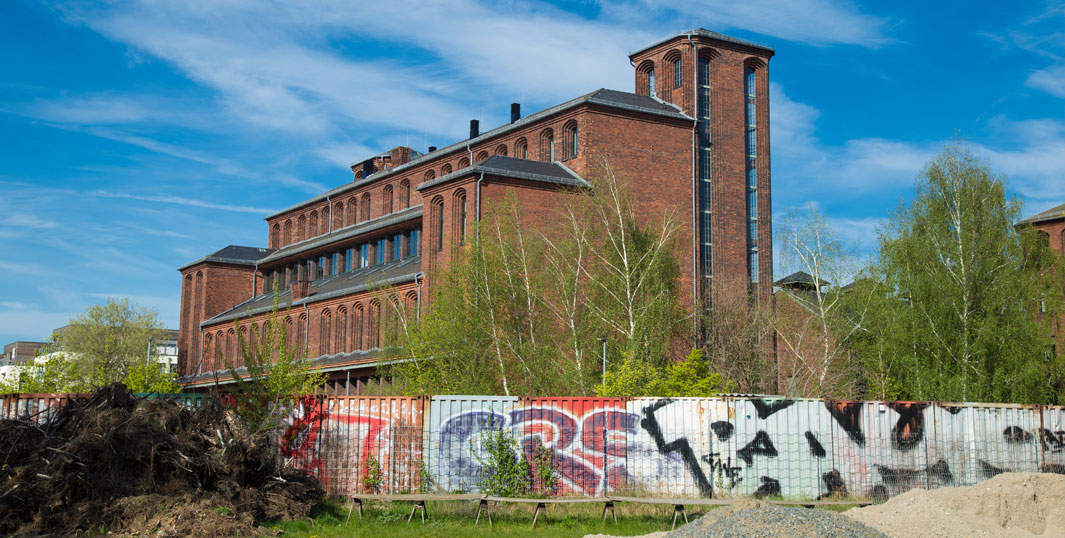
Berlin has another small district that few people know and that is consequently often underestimated. As part of East Berlin, Wilhelmsruh once bordered the western district of Reinickendorf. At Kopenhagener Straße, the road came to an end before the fall of the Wall. Today, like several other parts of Pankow, Wilhelmsruh is popular with young families, many of them with alternative lifestyles.
This community of just 8,000 residents, between Reinickendorf, Rosenthal and Märkisches Viertel, is a genuine residential oasis without major tourist attractions. That is precisely why authentic everyday life can still be found here, far removed from tourism. Nevertheless, there is plenty of history to discover.
The first major site is the extensive area now known as Pankow Park, formerly the VEB Bergmann-Borsig during the GDR era. Before reunification, this area had a very unusual location, right beside the Berlin Wall, in a triangle between Reinickendorf and Märkisches Viertel. The death strip surrounded the entire industrial site. Sections of the rear border wall can still be found there. They once served to prevent residents of Wilhelmsruh from entering or looking into the factory.
The Bergmann-Borsig works quickly became history after reunification. Today, companies such as General Electric and Stadler Deutschland, along with many smaller industrial and event businesses, occupy the former factory grounds. Many buildings are listed monuments; most have been restored and are in use. Some halls are still deteriorating because no investor has come forward. Other protected industrial buildings along the S-Bahn line have since been demolished.
The band Rammstein operates a shop in a restored former industrial hall in Pankow Park. The Heidekraut railway line is currently being reactivated. In the coming years, it is expected to connect Wilhelmsruh S-Bahn station with the northern Brandenburg countryside. The line runs through Pankow Park. The land belongs to NEB (Niederbarnimer Eisenbahn) and remains fenced off. The railway project has, however, caused resentment among some residents who built homes beside the former track after the line was closed 60 years ago.
At the main entrance to Pankow Park on Lessingstraße stands a large day-care centre. Few people know that these buildings once served as barracks for forced labourers during the Third Reich. Identical barracks stood on the opposite side of the street, but they have since disappeared and a car park now occupies the site. A discreet memorial plaque on the day-care centre grounds commemorates the forced labourers who died under inhumane conditions at the Bergmann electricity works between 1940 and 1945.
The district itself still has a village-like charm. Attractive late-19th-century houses appear among the many new buildings. Most of the GDR-era prefabricated apartment blocks have now been renovated and no longer look quite so bleak. Near the former Kopenhagener Straße border crossing and Wilhelmsruh S-Bahn station stands the former Wilhelmsruh transformer station. Built of brick in the style of New Objectivity, it remains an architecturally distinctive building.





 1. Regarding the sound ...


Add comment