

- Details
- Hendrik Lorenz
- Category: Blog
- Read Time: 4 mins
- Hits: 558
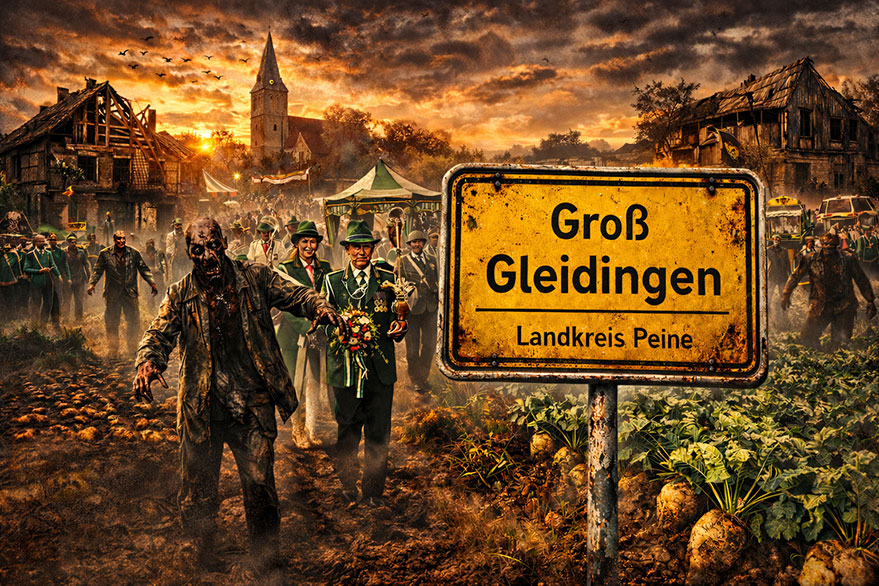
Some places have everything. And then there's Groß Gleidingen. A small village that was removed from the district of Braunschweig in 1974 and henceforth became part of the district of Peine. Probably not without reason. Braunschweig was now just 1 kilometre away, while Peine was 20 kilometres away. In the 1980s, this village was so consistently uneventful that even boredom eventually said, “I have to get out of here, and fast.” Nothing happened here. And that wasn't by chance. It was the system. Groß Gleidingen was – and still is – idyllically nestled among seemingly endless fields of sugar beet and potatoes. Truly endless. So endless that people sometimes wondered whether anything exciting might be waiting beyond the next field.
The day always began with the sound of “nothing”. Perhaps a tractor in the distance. Perhaps not. Nobody was ever quite sure whether that wasn't just self-deception, a way of pretending there was at least a little life around. The infrastructure was fairly modest. There was a bank and a post office, both run out of ordinary residential buildings. There was also a legendary supermarket. A “SPAR” store that also called itself an “Angling Centre”. This ingenious shop was run by Heidrun Krause. It managed to be both overpriced and poorly stocked. The prices were ambitious; the expiry dates were more a matter of interpretation. Nobody shopped there because they wanted to, but because there were no alternatives. The local football club was the village's sporting centre. People fought, ran and lost with passion. And, above all, something was happening. The annual marksmen's festival, however, was the absolute social highlight. The event of the year for every village idiot. At last, some movement, music, beer, drinking, heckling and throwing up. For a few days, Groß Gleidingen almost felt like a real place before the familiar tranquillity returned.
Going out in the evening beyond the village community made logistics interesting. There was a bus, but only in theory. In practice, the journey ended at night in Timmerlah. And from there it was: good luck getting home. Either walk along the road or take a romantic stroll through a field path in the dark. With a bit of luck, sober. With a bit of bad luck, not so much. Speaking of not being sober: the many gravel pits around the village were the real centre of life in summer. People swam, chilled out and, above all, drank. That was one of the few places where anything resembling an atmosphere emerged. Sun, water, beer. That was all it took to turn Groß Gleidingen temporarily into a kind of improvised holiday resort. The 1980s were supposed to be colourful, loud and full of music, pop culture and neon colours. Groß Gleidingen, on the other hand, collectively opted for a different concept: stagnation.
Conclusion: Even after 30 years away from this village, Groß Gleidingen still looks just as it did in the 1980s. Visually, hardly anything has changed. Complete stagnation. One positive point worth mentioning is the expansion of the new housing estate around Wiedenkamp. The rest of the village remains suitable only as a low-cost backdrop for the next zombie blockbuster.


More Articles …
- Seminar on the Inner German Border – or: How I Learned to Love a Beer Vending Machine (Zicherie, 1987)
- Sachsenhausen Concentration Camp in Oranienburg near Berlin – A Different Kind of Camp
- After a Seven-Year Break – Easter Bonfire Returns to Berlin-Frohnau
- Merkel's Skilled Worker of the Month – March 2026


 1. Regarding the sound ...