

- Details
- Hendrik Lorenz
- Category: Blog
- Read Time: 7 mins
- Hits: 482
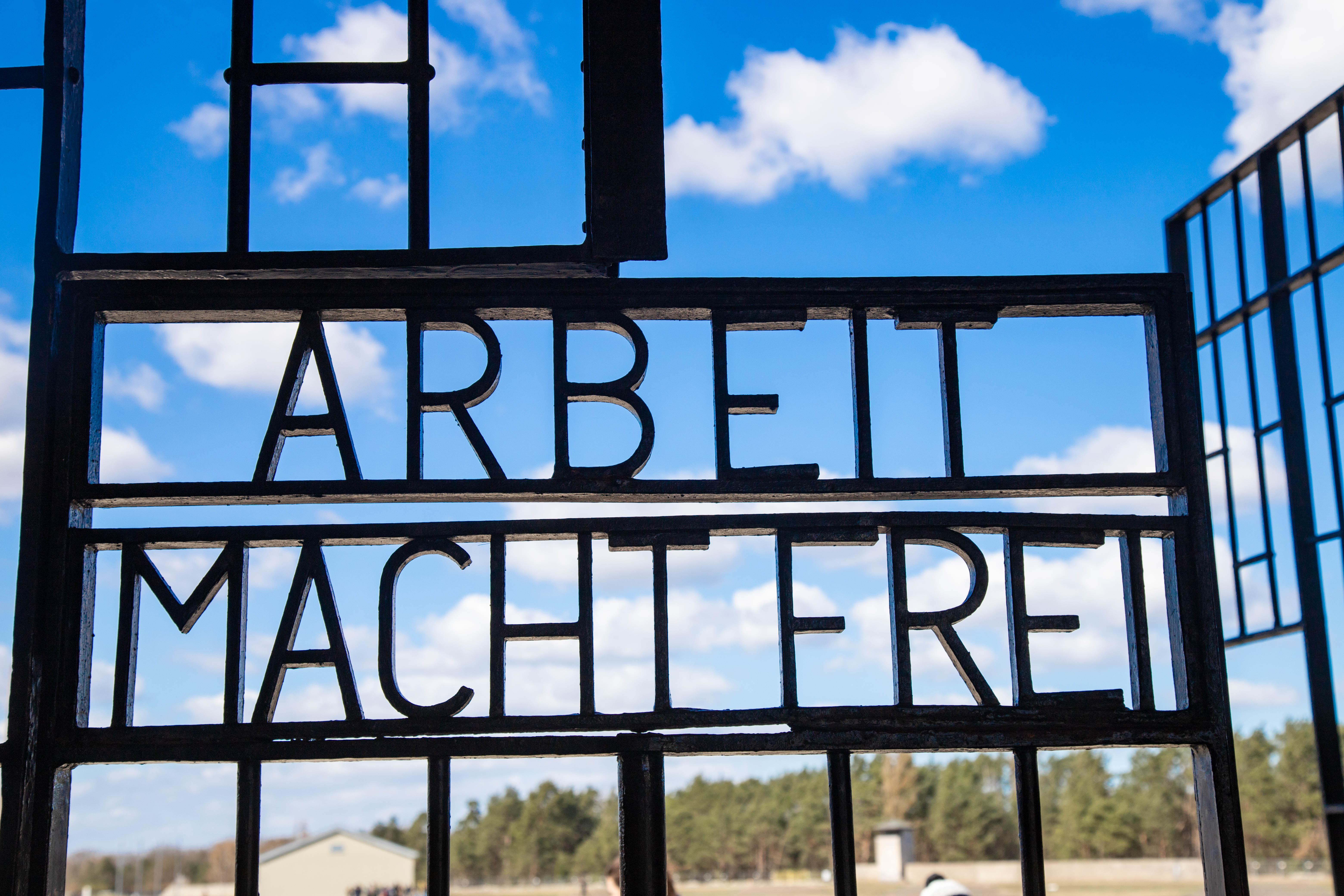
On the orders of the SS, what is now the Sachsenhausen Memorial was established as a concentration camp in 1936. The camp is located about 35 kilometres north of Berlin, in the town of Oranienburg. It was not an improvised hiding place, but a deliberately planned model camp. It was intended to demonstrate what a camp designed to systematically dehumanise, control and destroy people should look like. Because of its proximity to Berlin, then the capital of the Reich, the camp was a clear symbol of the power of Nazi rule.
The camp's architectural design was based on geometric control. From the commandant's headquarters, a watchtower could keep every barrack in view. The architecture itself was intended to display power – a place where people were not merely imprisoned, but turned into objects of total subjugation.
At first, mainly political opponents of the Nazi regime were deported to the camp. They were followed by people from across Europe who were abducted after their countries had been occupied. Jews, Sinti and Roma, homosexuals, prisoners of war and everyone the Nazi government disapproved of ended up at Sachsenhausen concentration camp.
The prisoners were forced to perform hard labour. Initially this took place inside the camp itself, and later in more than 100 satellite camps located near armaments factories, such as aircraft plants and other industrial facilities. Conditions were inhumane, as in every concentration camp. Malnutrition, disease, abuse and often death from exhaustion were part of everyday life at Sachsenhausen. In the autumn of 1941, the SS began murdering thousands of Soviet prisoners of war using a specially constructed facility and during the testing of gas vans. Soon afterwards, a complex containing a gas chamber and killing installations was built inside the camp.
As Soviet troops approached in 1945, the SS attempted to evacuate the camp. More than 30,000 prisoners were sent on foot towards the northwest, without food or protection. These became known as the “death marches”. Many prisoners died along the way.
After the Second World War, the site continued to be used for a time as a Soviet special camp. Thousands of people also suffered and died in this facility. The victims included former guards and people persecuted for political reasons. The history of the site remained marked by suffering and human tragedy.
One of the best-known prisoners at Sachsenhausen concentration camp was Heinrich George. Born in Stettin in 1893, Heinrich George quickly established himself as one of Germany's most important actors. He initially performed on the stage and later appeared in films. During the Weimar Republic, he was considered politically left-wing and was even a member of the Communist Party. During the Nazi era, he moved closer to the National Socialists and was therefore imprisoned by the Soviets after the war and transferred to the Sachsenhausen special camp, where he died in 1946.
Very close to the former Sachsenhausen concentration camp is the old SS bakery in Oranienburg, often also called the SS bread factory. It was no ordinary bakery building. The factory was built in 1939 by prisoners from Sachsenhausen concentration camp and was later operated by them as well. It is located in Oranienburg on the Oder-Havel Canal, near what was then Federal Highway 273. The bakery was intended to supply bread to SS units, Sachsenhausen concentration camp and, later, other SS offices. The quantities produced were enormous: initially around 10,000 loaves a day, and later – after shift work and additional ovens were introduced – more than 40,000 loaves per day. Around 80 prisoners from Sachsenhausen worked in the factory. Every day they had to march several kilometres from the camp to the bakery and work there under SS supervision. After the end of the Second World War, the Red Army briefly used the bakery to feed surviving prisoners from Sachsenhausen who were ill and weakened. In 1946, the operation was transferred to a consumer cooperative and, from 1948, continued as the VEB Konsum-Großbäckerei Oranienburg until 1991. The bread factory now stands empty and is derelict. Parts of the interior were destroyed by fire in 1994. Although the building is listed, it is not open to the public and is currently in very poor condition.
Next to the old bakery is the site of the former Oranienburg brickworks. From the late summer of 1938, the Oranienburg brickworks operated as a large brickmaking and brick-production facility near the Lehnitz lock on the Oder-Havel Canal, about two kilometres from the main Sachsenhausen camp. It was intended to produce huge quantities of building materials required by the Nazis for their planned transformation of Berlin into the “World Capital Germania”. Thousands of Sachsenhausen prisoners were driven to work at the brickworks every day. They had to build the facility, press, fire and transport bricks – often under brutal conditions, with inadequate food and no regard for their health. On the way back to Sachsenhausen, they often had to pull a cart carrying the bodies of those who had died that day – a sign of the brutality of the labour regime. The SS also used the brickworks as a site for targeted murder operations, which filled the prisoners with fear. On 10 April 1945, the brickworks was almost completely destroyed in an Allied air raid. Many prisoners were killed. The SS then cleared the camp and took the remaining prisoners back to Sachsenhausen. After the war, most of the remaining facilities were demolished, and the site was initially put to other uses. The area has been listed as a historic monument since 1996.
Conclusion: A visit to the former Sachsenhausen concentration camp is definitely worthwhile. I was very surprised by the size of the camp and the adjoining administrative buildings of the camp commandant's office and the SS troop camp (most of which are still preserved). Although this camp cannot be compared with a typical extermination camp such as Auschwitz-Birkenau, it does provide a good insight into the kind of institution used at the time for people deemed undesirable. Many buildings in the actual camp no longer survive; the few remaining barracks house exhibitions and documentation. Anyone with time should also visit the satellite sites (the SS bakery and the brickworks near Lehnitz lock). However, these memorial sites are difficult to reach because of their distance from the main camp.